
Table of Contents
SMS routing is often treated as a background mechanism inside delivery infrastructure. A message arrives, the gateway selects a path, and the SMS is pushed toward delivery. Simple enough.
But in real-world A2P messaging, routing is not just a technical step in the delivery chain. It is where commercial priorities, delivery quality, throughput limits, provider availability, customer requirements, and operational policy all meet.
That makes routing one of the most important control points in the entire SMS delivery process.
SMS Routing Is More Than Path Selection
At its most basic level, routing decides where a message should go next.
But modern SMS delivery rarely depends on one static route. Different destinations may require different providers. Some routes may be more cost-effective, while others may offer better delivery performance. Certain customers may need dedicated routes. Some traffic may require stricter throughput control. Providers may become unavailable, unstable, congested, or temporarily unsuitable.
In that environment, routing becomes less about “send this message through provider X” and more about applying delivery logic in real time.
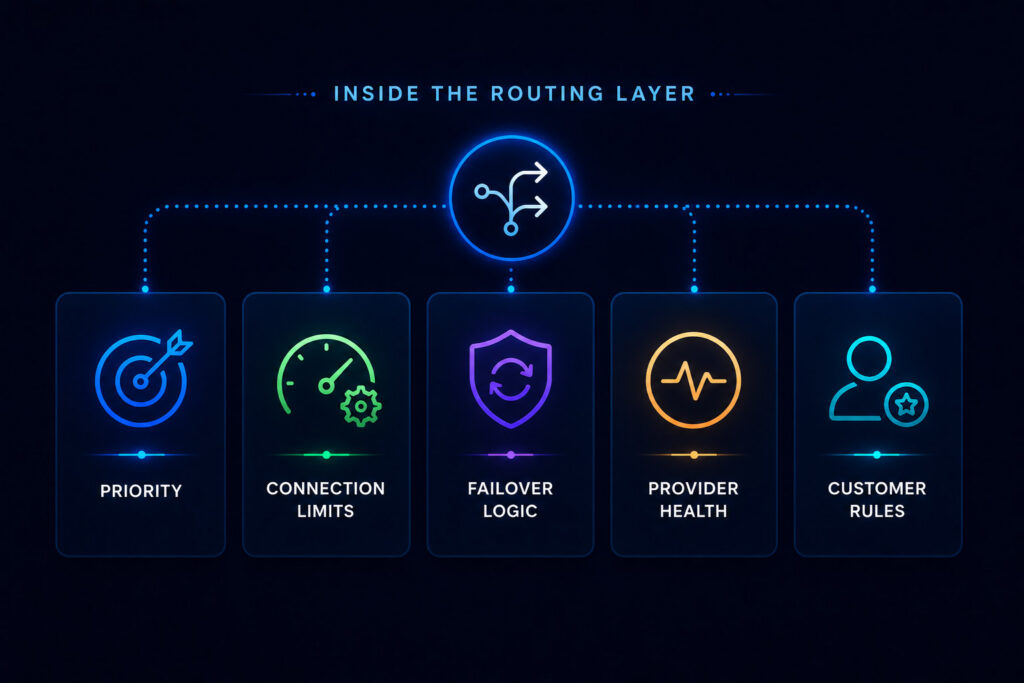
A routing layer answers questions such as:
Which provider should handle this message?
What happens if that provider fails?
Which provider or worker should handle this message?
What happens if that route is unavailable?
Does this customer require a specific routing path?
Is there a fallback rule?
Which connection-level limits or delivery constraints will apply after routing?
Should route behavior change without interrupting service?
Does this customer require a specific route?
Is there a fallback path?
Should route behavior change without interrupting service?
Those questions are not secondary. They define how the platform behaves under pressure.
The Operational Value of Routing
A strong SMS routing layer gives operators the ability to shape delivery behavior without constantly changing the surrounding systems.
This matters because SMS traffic is dynamic. Volumes change throughout the day. Customer needs evolve. Provider performance fluctuates. New routes are added. Old routes are deprecated. Business rules change. Compliance requirements may differ by market, customer, or destination.
Without flexible routing, every change becomes heavier than it needs to be. Operations teams may need manual intervention, configuration workarounds, service restarts, or custom logic outside the gateway itself.
With proper routing control, the gateway becomes more adaptable. It can support route selection, fallback behavior, customer-specific logic, and cleaner separation between routing policy and connection-level delivery constraints.
This is why routing should not be viewed as a minor gateway feature. It is part of the platform’s control plane.
Delivery Quality Depends on Routing Decisions
Many SMS routing problems are not caused by the message itself. They are caused by the path the message takes.
A route may be technically available but commercially unsuitable. Another route may be cheaper but less reliable for a specific destination. A provider may perform well for one market and poorly for another. A single route may be stable at low volume but unreliable under higher load.
Good routing logic helps operators respond to these realities.
It allows them to direct traffic based on more than static configuration. It creates space for operational policy: which route is preferred, which route is a fallback, which traffic needs special handling, and how the system should behave when conditions change.
This is where SMS delivery becomes a managed process rather than a simple forwarding mechanism.
Routing and Connection Constraints Must Work Together
Routing decisions do not exist in isolation from the connections that ultimately carry the traffic.
For readers who want to explore the technical side, Sendium’s routing documentation explains how messages are evaluated and dispatched through routing tables, while the SMPP configuration documentation covers connection and worker-level limits.
A routing rule may decide that a message should be sent to a specific worker, provider route, or fallback path. The actual throughput limits, however, belong to the connection or worker configuration behind that route. This distinction matters.
In practice, routing determines where traffic should go. Connection-level configuration determines how that traffic is handled once it reaches that path.
This allows operators to separate decision logic from delivery constraints. The routing layer can dispatch messages based on customer rules, sender ID, message type, destination logic, or fallback behavior, while each provider connection can maintain its own limits, rate configuration, binding behavior, and operational characteristics.
That separation is important for maintainability. It avoids mixing routing policy with transport-level constraints, while still allowing both layers to work together as part of the same delivery architecture.
Why This Matters for Gateway Architecture
As SMS routing requirements become more complex, the routing layer becomes a more important part of gateway architecture.
A gateway that only forwards traffic can work in simple environments. But as soon as traffic becomes more complex, the architecture needs a stronger decision layer behind the entry point.
This builds on a broader architectural idea: modern SMS infrastructure should not depend on a single protocol or a single static integration pattern.
That decision layer should help operators manage routes, adjust behavior, apply fallback logic, and separate routing policy from connection-level delivery constraints.
It also connects naturally with the idea that Kannel-style compatibility can remain familiar at the interface level, while the behavior behind that interface becomes more flexible and operationally capable.
This is one of the areas where Sendium is designed to provide a more modern foundation for SMS delivery. By treating routing as a core part of gateway behavior, Sendium gives operators a more structured way to manage how messages move through their infrastructure.
The goal is not only to send SMS traffic. The goal is to control how that traffic is handled.
Routing Is Where Strategy Becomes Execution
In SMS routing, strategy becomes execution
Routing is where those ideas become practical.
It is where the platform decides how to balance cost and quality.
It is where fallback logic becomes operational resilience.
It is where customer-specific requirements become executable rules.
It is where throughput limits become controlled traffic flow.
It is where infrastructure becomes manageable at scale.
That is why routing should not be treated as a hidden technical detail.
In modern SMS infrastructure, routing is the control plane of delivery.