


Table of Contents
SMS infrastructure has never been a single-protocol environment.
Even today, when many messaging platforms expose clean HTTP or REST APIs to customers, the delivery layer behind those APIs often still depends on SMPP connections, operator connectivity, SMSCs, hubs, aggregators, routing agreements, throughput limits, delivery receipts, and provider-specific behavior.
That is not a contradiction.
It is how the SMS ecosystem actually works.
Modern SMS infrastructure is layered. Different systems speak different protocols because they serve different roles. A customer-facing API, an internal messaging platform, an SMS aggregator, an MNO, a CPaaS provider, and an SMSC do not all sit at the same point in the chain.
This is why a modern SMS gateway should not be designed around the assumption that one protocol can cover every operational need.
It needs to bridge layers.
HTTP Is Often the Interface. SMPP Is Often the Transport Layer.
For many companies, HTTP is the natural integration layer.
A SaaS product, CRM, authentication service, e-commerce platform, banking application, or IoT platform will usually prefer an HTTP-based interface. It is familiar, easy to document, easy to test, and fits naturally into modern software stacks.
This is why many SMS providers, aggregators, and CPaaS platforms offer HTTP or REST APIs. Their customers do not need to understand binds, PDUs, delivery receipt formats, or provider-side SMPP behavior. They need a clean way to submit messages, receive responses, and track outcomes.
But that does not mean SMPP disappears.
In many cases, the HTTP API is the surface layer. Behind it, the platform may still route traffic through SMPP connections to SMSCs, carriers, hubs, aggregators, or other upstream providers.
So the real distinction is not:
HTTP or SMPP.
The real distinction is:
Which protocol belongs at which layer?
HTTP is often ideal for application-facing integration.
SMPP remains deeply relevant for telecom-grade messaging connectivity.
A serious gateway needs to respect both.
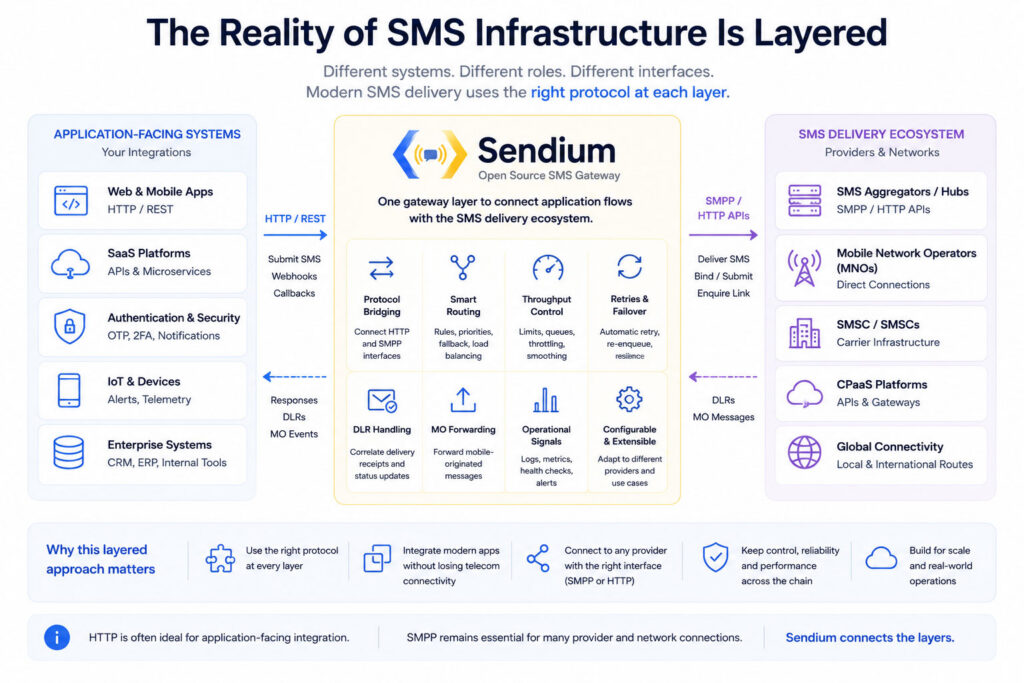
The SMS Chain Has Different Actors with Different Interfaces.
It is also important not to treat the whole telecom side as one uniform block.
An MNO, an SMSC, an SMS hub, an aggregator, and a CPaaS provider may expose very different interfaces.
Some may provide SMPP only.
Some may provide HTTP APIs.
Some may provide both.
Some may expose a simplified API while using SMPP deeper in the stack.
Some may operate multiple interfaces depending on customer type, traffic class, or commercial agreement.
That is why protocol support is not just a checkbox.
A gateway layer has to sit comfortably in mixed environments. It may need to accept traffic from HTTP applications, support downstream SMPP clients, connect to upstream SMPP providers, and return delivery feedback to systems that expect callbacks or other application-friendly mechanisms.
The value is not in pretending the ecosystem is simpler than it is.
The value is in managing that complexity cleanly.
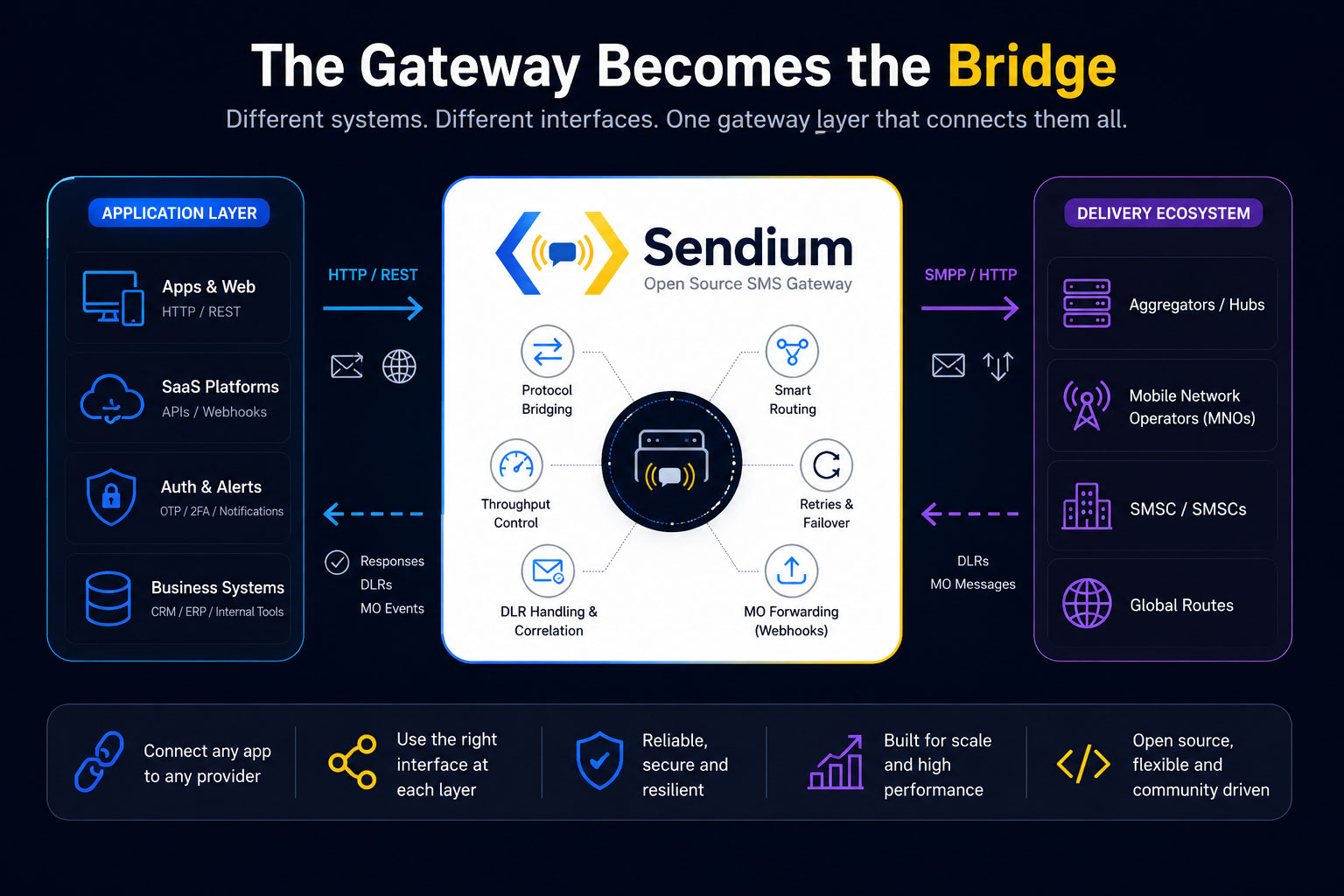
Protocol Bridging Is an Operational Requirement.
In SMS infrastructure, protocol bridging is not only about developer convenience.
It affects operations.
A platform may need HTTP ingress for modern applications, but SMPP connectivity for upstream delivery.
It may need to accept SMPP from existing enterprise or reseller systems.
It may need to route different traffic types to different providers.
It may need to handle DLRs from upstream connections and map them back to the originating system.
It may need to forward mobile-originated messages to application endpoints.
These flows require more than basic message forwarding.
They require a gateway that understands where a message came from, how it should be routed, how provider responses should be handled, and how delivery feedback should return to the right origin.
That is where a multi-protocol gateway becomes valuable.
Not because it makes HTTP or SMPP “better” than the other, but because it allows each protocol to be used where it makes sense.
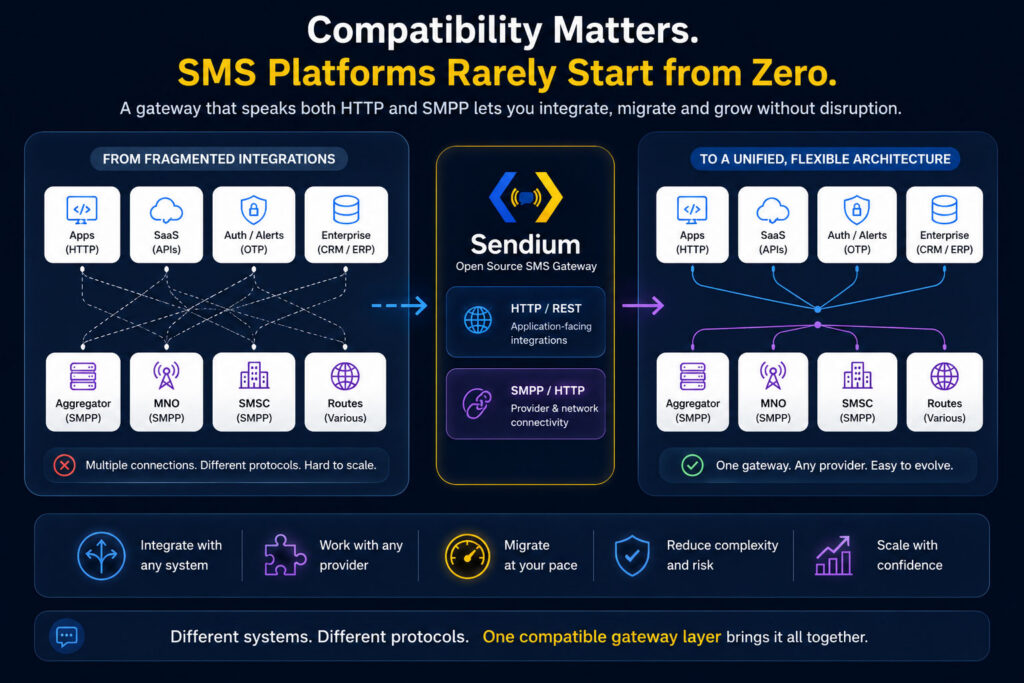
Compatibility Matters Because SMS Platforms Rarely Start from Zero.
Most SMS infrastructure is not built on a clean sheet.
Companies may already have customer integrations, internal tooling, SMPP clients, HTTP submission flows, legacy routing rules, provider-specific behavior, and operational processes that have been built over many years.
This is especially true for teams coming from older gateway models such as Kannel-style HTTP integrations or SMPP-based setups.
A modern gateway should not force every team into a rip-and-replace migration.
It should allow gradual modernization.
That means preserving useful integration patterns where they still make sense, while improving the underlying gateway model: deployment, routing, configuration, throughput handling, delivery feedback, and operational control.
Compatibility is not about staying in the past.
It is about reducing migration friction so teams can move forward without unnecessary disruption.
Sendium’s Approach
Sendium is built for this mixed reality.
It is an open-source, headless SMS gateway designed to connect modern application flows with telecom messaging infrastructure. Its role is not to declare one protocol as the future and another as legacy. Its role is to sit between layers and make them work together.
Sendium supports HTTP-based SMS submission, including Kannel-compatible GET /sendsms style flows, while also supporting SMPP connectivity for downstream clients and upstream providers.
This allows different systems to interact with the gateway in the way that fits their role.
An application can submit through HTTP.
An SMPP client can connect through SMPP.
The gateway can route traffic to SMPP providers.
Delivery receipts can be correlated back to the originating side.
Mobile-originated messages can be forwarded to HTTP endpoints.
That makes Sendium useful not only as a protocol bridge, but as a control layer for message flow.
The Real Value Is Not Protocol Support Alone.
Supporting HTTP and SMPP is important, but protocol support by itself is not enough.
The more important question is what happens after the message enters the gateway.
How is it routed?
How is throughput controlled?
What happens if a provider path fails?
How are delivery receipts handled?
How are mobile-originated messages passed back to business systems?
How can operators adapt configuration without unnecessary operational friction?
This is where the gateway becomes strategic.
The gateway is not just the place where protocols meet. It is the place where traffic policy, routing logic, provider behavior, delivery feedback, and operational control come together.
That is the layer Sendium is designed to address.
Modernization Should Not Mean Ignoring Telecom Reality.
Many modern software teams prefer clean APIs, cloud-native deployment, and developer-friendly integration. That is reasonable.
But SMS delivery still depends on telecom infrastructure with its own protocols, constraints, and operational expectations.
A modern SMS gateway cannot ignore that reality.
It has to support application-facing simplicity without losing telecom-grade connectivity. It has to provide a usable bridge between HTTP-native systems and SMPP-based messaging flows. It has to support teams that are modernizing, without assuming they can abandon existing integrations overnight.
That is why modern SMS infrastructure cannot live in one protocol only.
Not because every system must use both HTTP and SMPP directly.
But because the SMS chain itself is made of different layers, and each layer may require a different interface.
The strongest gateway is the one that understands this.
It lets applications integrate cleanly.
It lets telecom connections operate properly.
It lets operators control the flow between them.
And it gives teams a path to modernize without breaking what already works.
That is the role Sendium is built to play.