
Table of Contents
SMS fallback routing starts with a simple operational question: what should happen when the first route fails?
In SMS delivery, that scenario should never be treated as exceptional. It is part of normal SMS gateway operations.
A provider can become unavailable. An SMPP bind can drop. A route can remain technically connected while performance starts degrading. A specific destination network may begin returning errors, or delivery receipts may start arriving later than expected. From the outside, these situations may all look like “route failure”, but operationally they are not the same thing.
That is why fallback routing matters.
It is not just a backup mechanism. It is the logic that decides what should happen next when the preferred path is no longer the best path.
SMS Fallback Routing Is More Than Trying the Next Route
The simplest version of fallback routing is easy to describe: if Route A fails, send the message through Route B.
In real SMS infrastructure, that is rarely enough.
A fallback decision has to consider what kind of failure happened, how important the traffic is, whether another provider is eligible for that destination, whether the message can safely be retried, and whether switching routes could create new operational problems. Treating fallback as a blind redirect may solve one issue while creating another.
For example, a failed submission is different from a delayed delivery receipt. A provider reject is different from a temporary throughput limit. A broken bind is different from a route that is technically alive but performing badly. If the gateway reacts to all of these situations in the same way, fallback becomes unpredictable.
The goal is not simply to keep sending.
The goal is to keep sending intelligently.
The First Route May Not Fail Completely
SMS fallback routing becomes more valuable when the gateway can react to route degradation before a complete outage happens.
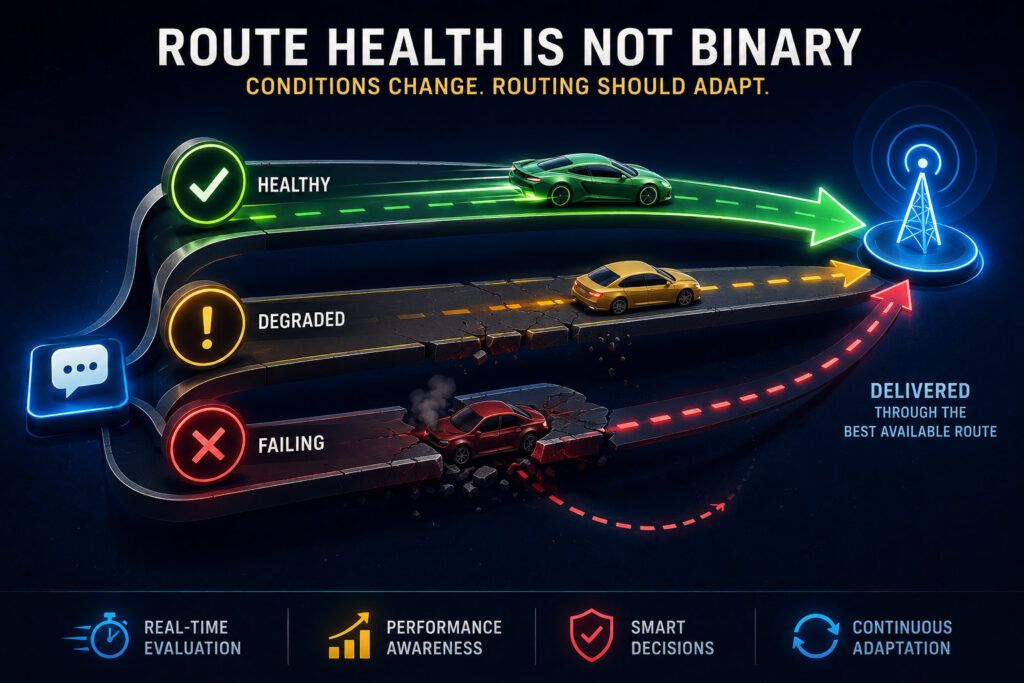
One of the challenges in SMS routing is that failure is not always binary.
A route may still accept messages but deliver them slowly. It may perform well for one country and poorly for another. It may work for transactional traffic but become unsuitable for bulk campaigns during peak load. In other cases, the provider connection may remain stable, while the downstream path toward a specific mobile network becomes the real problem.
This matters because a gateway should not wait for total failure before making better routing decisions.
A modern SMS operation needs to recognize route health as a changing condition. Availability is important, but it is only one part of the picture. Delivery behavior, response codes, queue pressure, latency and receipt patterns can all become signals that the first route is no longer the right route for every message.
Fallback routing becomes much more useful when it is connected to operational context.
Bad Fallback Can Make an Incident Worse
Fallback is often described as a safety feature, but poorly designed fallback can increase risk.
Poorly designed SMS fallback routing can create new problems instead of solving the original delivery issue.
If a gateway retries too aggressively, it can create duplicate messages or unnecessary provider load. If it switches too quickly, it may move traffic away from a route that was only experiencing a short delay. If it ignores destination-specific behavior, it may send messages through a technically available route that is not suitable for the target network.
There is also a commercial side to the decision. The backup route may be more expensive. It may have different quality characteristics. It may be appropriate for urgent transactional messages but not for lower-priority traffic. In SMS operations, the “next available route” is not always the right operational answer.
That is why fallback needs policy.
A gateway should not only know where it can send traffic. It should understand when it should change direction, how quickly it should react, and which traffic is allowed to move to another path.
Different Traffic May Need Different Behavior
Not every SMS deserves the same fallback strategy.
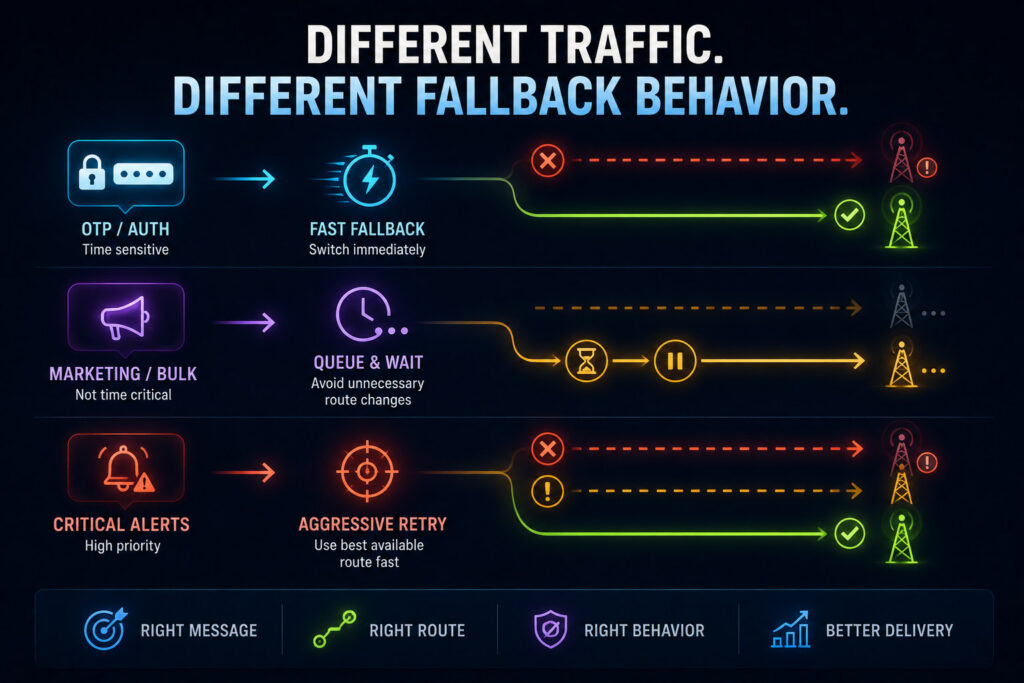
SMS fallback routing should also depend on the type of message being handled.
An OTP message usually has a very short useful lifetime. If the first route is unavailable or clearly failing, a fast fallback decision may be necessary. Waiting too long could make the message useless even if it eventually arrives.
A marketing campaign is different. In that case, the safest response to route degradation may not be immediate failover. It may be better to slow down, queue, pause or wait for the route to recover, depending on cost, compliance requirements and customer expectations.
Operational messages may require another approach again. A critical notification may justify a more aggressive retry strategy, while routine informational traffic may not.
This is where routing becomes more than connectivity. The gateway is not just moving messages from one technical endpoint to another. It is applying business and operational logic to delivery.
Fallback Should Be Observable
SMS fallback routing is only useful if operators can understand when and why the gateway changed route.
When traffic moves from one route to another, operators need visibility into the reason. Was the primary route down? Was the provider returning errors? Was traffic shifted because of throughput pressure? Did the fallback happen for all messages, or only for a specific destination or customer?
Without that visibility, failover becomes another black box.
This creates problems during incident review. A team may know that traffic eventually delivered, but not why the original route stopped being used. They may see higher cost, changed delivery behavior or customer complaints without being able to connect them to a specific routing decision.
Good fallback routing should leave an operational trail.
It should help teams understand not only that a message was rerouted, but why the gateway made that decision at that moment.
Fallback Is Part of Routing Strategy
Fallback should not be treated as a separate emergency feature bolted onto the side of the gateway.
It belongs inside the routing strategy.
The same system that decides the preferred route should also understand what happens when that preference stops being valid. This is especially important in environments with multiple providers, mixed traffic types, country-specific rules and different customer requirements.
A route plan that only works when everything is healthy is incomplete.
The real test is what happens during pressure: provider instability, changing delivery quality, queue buildup, throughput limits or partial downstream issues. A gateway that can adapt during those moments gives teams more control over the operational reality of SMS delivery.
That control does not need to be complicated for the sake of complexity. In fact, the opposite is true. Fallback logic should be clear enough for operators to reason about, test and adjust.
Why This Matters for SMS Teams
SMS teams are often judged by delivery outcomes, not by the complexity behind them.
Customers usually do not care which provider was used, which bind was active, or which routing rule was triggered. They care whether the message arrived, whether it arrived on time, and whether the service behaved reliably.
Behind that simple expectation sits a lot of infrastructure logic.
Fallback routing helps protect that expectation when the first path is no longer reliable. It gives the gateway a way to respond to changing conditions without requiring manual intervention for every incident. It also gives operators a way to design safer delivery behavior before the incident happens.
This is the difference between reactive operations and controlled routing.
Where Sendium Fits
Sendium is being built around the idea that SMS gateway behavior should be open, configurable and operationally understandable.
Fallback routing fits naturally into that philosophy. In a real A2P messaging environment, routing decisions should not be hidden inside a black box or locked behind assumptions that operators cannot inspect. Teams need to understand how traffic is routed, how provider connections behave, and how the gateway should react when the preferred path is no longer the right one.
In Sendium, fallback can be handled in practical ways at the routing layer.
One example is a failed SMS submission. If a submit_sm attempt fails, the message can be routed again with its retry counter increased. That retry count can then become part of the routing decision, helping the gateway avoid sending the same message to the same operator repeatedly when another route should be tried.
For example, a routing setup could prefer operator2 once the retry count is greater than 1, while keeping operator1 as the default route:
operator2:rtxCnt:>:1
operator1::default:
This gives the routing layer a simple but useful signal: if the message has already failed before, try a different path instead of blindly repeating the same one.
Another example is connection availability. If the connection to an operator is lost, Sendium can skip that operator during routing and use the next available route. In a simple routing setup like this:
operator2::default:
operator1::default:
if operator2 is not connected, the gateway can move on to operator1 instead of treating the route list as static.
These examples show why fallback routing is not only about having a backup provider. It is about giving the gateway enough routing context to make a better decision when conditions change.
For teams evaluating or building SMS infrastructure, this matters because fallback behavior should be something they can reason about, test and improve. A gateway should make it possible to define routing behavior in a practical way, observe what happens during delivery, and adjust the setup without treating every routing problem as a manual incident.
The goal is not to make fallback routing unnecessarily complex.
The goal is to make it controllable.
Because in SMS delivery, the first route will not always be the best route.
The real question is whether the gateway knows what to do next.