


Table of Contents
SMS gateway traffic pressure is not only about how fast a platform can send messages.
In SMS gateway operations, speed is only one part of the story. A platform may receive traffic faster than a provider can accept it, a customer may launch a campaign that suddenly increases volume, or a downstream connection may remain available while still enforcing strict throughput limits.
In all of these cases, the question is not simply how fast the gateway can send.
The real question is how predictably the gateway behaves under pressure.
That is where TPS limits, queues and traffic control become important.
TPS Is Not Just a Performance Number
SMS gateway traffic pressure becomes harder to manage when throughput limits are treated only as technical constraints, rather than as part of the operating model.
TPS, or Transactions Per Second, is often treated as a headline metric. It is easy to talk about how many messages a system can process per second, and it is tempting to use that number as a simple measure of performance.
In real SMS infrastructure, TPS is more than speed.
It is also a boundary.
A provider may allow a certain number of submissions per second. A specific SMPP connection may have its own limits. A customer account may need to be restricted to avoid overwhelming downstream systems. Some traffic may be time-sensitive, while other traffic can safely move more slowly.
This means that a gateway should not only be able to send messages quickly. It should also be able to slow down in a controlled way when traffic exceeds what the surrounding infrastructure can safely handle.
A gateway that only optimizes for maximum sending speed can easily create instability elsewhere in the chain, especially when provider limits, queue buildup or delayed delivery feedback begin to affect the rest of the operation.
SMS Gateway Traffic Pressure Is Normal
For Sendium, SMS gateway traffic pressure is part of the broader operational control problem: how traffic enters the gateway, how it is queued, and how it moves toward provider connections at a sustainable rate.
Traffic pressure does not always mean something is wrong.
It can happen during a campaign, a seasonal spike, a large customer batch, or a temporary delay on the provider side. It can also happen when incoming HTTP traffic reaches the gateway faster than outgoing SMPP submissions can be accepted.
From the application side, everything may look normal. Messages are being submitted, requests are being accepted, and traffic is flowing into the platform. The pressure appears later, inside the gateway layer, where incoming demand has to be matched against available sending capacity.
This is one of the reasons SMS gateways need proper queue behavior.
A queue is not simply a place where messages wait. It is the part of the system that absorbs pressure when the input side and output side are not moving at the same speed.
Without that buffer, a spike becomes an incident much faster.
Queues Should Protect the System, Not Hide Problems
When SMS gateway traffic pressure builds inside the queue, the issue is not only that messages are waiting. It is that delivery behavior has already started to change.
A queue can make an SMS platform more resilient, but it can also create confusion if operators do not understand what is happening inside it.
When messages begin to accumulate, the gateway may still be running. The provider connection may still be active. The application may still be submitting traffic. But delivery behavior has changed, because the gateway is now managing a backlog.
That backlog matters.
If the queue grows faster than it drains, delivery time increases. If messages remain queued too long, some of them may lose business value. An OTP that arrives too late is not very useful, even if it was eventually delivered. A marketing message may tolerate more delay, but it still needs predictable handling.
This is why queues should not be treated as invisible storage.
They should be part of the operational model.
A healthy gateway needs to manage queued traffic with clear behavior, not simply keep accepting messages until the problem becomes harder to understand.
Throughput Control Creates Predictability
Throughput control helps create predictable delivery behavior.
Instead of allowing every sender, customer or connection to push traffic as fast as possible, the gateway can enforce limits that match the operational reality of the environment. This protects provider connections, reduces the risk of rejection due to excessive submission rates, and helps prevent one traffic source from consuming capacity that other traffic depends on.
The point is not to make the system artificially slower.
The point is to make traffic flow at a rate the infrastructure can sustain.
In SMS operations, predictability is often more valuable than short bursts of maximum speed. A gateway that sends too aggressively may appear fast for a short period, but the result can be higher queue pressure, provider rejects, delayed receipts or inconsistent delivery behavior.
A controlled system is easier to reason about.
It is also easier to operate during busy periods.
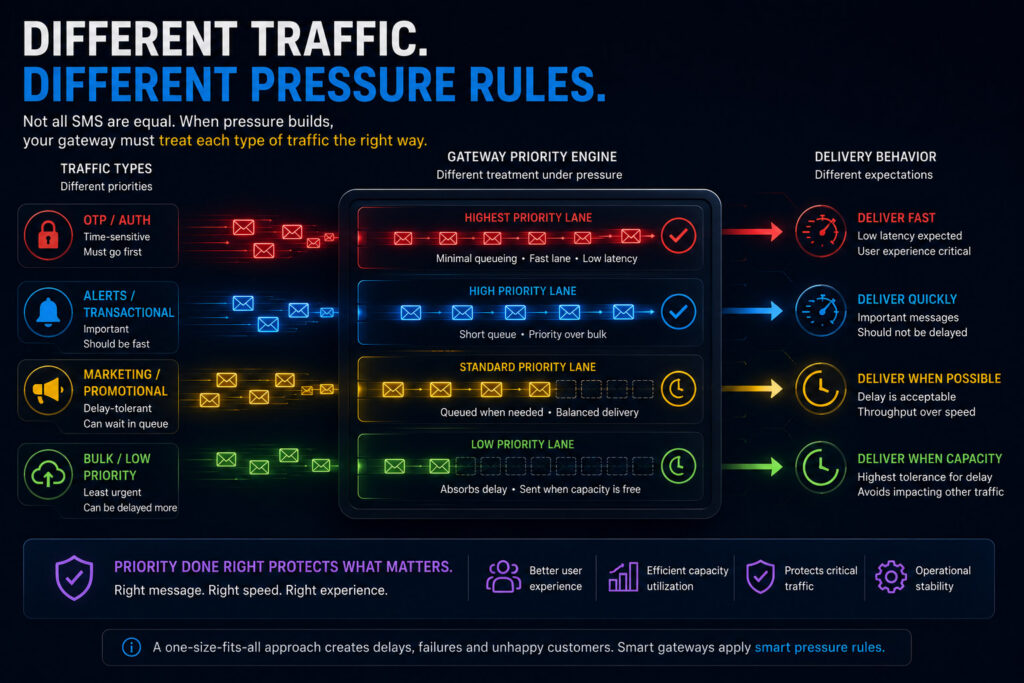
Not All Traffic Pressure Should Be Handled the Same Way
When a gateway is under pressure, the right behavior depends on the type of traffic being handled.
Some messages are time-sensitive. Authentication codes, alerts and transactional notifications often need to move quickly or fail clearly. Other traffic may tolerate delay, especially if the business requirement is volume completion rather than immediate delivery.
This difference matters because queue behavior should reflect operational priorities.
If every message is treated the same way, critical traffic can be delayed behind lower-priority batches. If every traffic spike is handled with the same limits, the gateway may protect the connection but still produce poor service behavior for the messages that matter most.
A mature SMS gateway should make it possible to think about traffic in terms of pressure, priority and delivery expectations.
That does not mean every setup needs to be complex. It means the gateway should give operators enough control to avoid turning traffic management into guesswork.
Pressure Can Come From Both Sides
Traffic pressure is not only caused by too much incoming volume.
It can also come from downstream constraints.
A provider may reduce available throughput. A connection may become slower to respond. A destination path may behave differently during peak hours. The gateway may have enough incoming capacity, but limited outgoing capacity toward one provider, bind or route.
This is where SMS infrastructure becomes more than message submission.
The gateway has to balance what enters the system with what can safely leave it.
If it only focuses on accepting traffic, it may create a growing backlog. If it only focuses on sending as fast as possible, it may create pressure on provider connections. The operational challenge sits between those two sides.
Good gateway behavior depends on understanding both.
Operational Visibility Matters
Traffic pressure should be visible before it becomes a customer-facing problem.
Operators need to know when queues are growing, when throughput limits are being reached, and when the gateway is no longer draining traffic at the expected rate. They also need to understand whether pressure is caused by incoming traffic, outgoing capacity, provider behavior or configuration limits.
Without this visibility, teams can easily misread the situation.
A delivery delay may look like a provider issue when the real problem is queue buildup. A queue buildup may look like insufficient capacity when the real cause is a strict throughput limit. A throughput limit may look like a bottleneck when it is actually protecting the platform from worse behavior downstream.
This is why operational signals matter.
Not every signal needs to become a dashboard, but the system should expose enough information for teams to understand what is happening and respond with confidence.
Where Sendium Fits
For Sendium, SMS gateway traffic pressure is part of the broader operational control problem: how traffic enters the gateway, how it is queued, and how it moves toward provider connections at a sustainable rate.
Sendium approaches the SMS gateway as an operational control layer, not only as a protocol bridge.
That distinction is important when dealing with TPS, queues and traffic pressure. In a real messaging environment, the gateway should not only receive messages and forward them to providers. It should help control how traffic moves through the system.
This includes practical concerns such as throughput limits, queue behavior and provider-side capacity. If a connection can only accept a certain rate, the gateway needs to respect that. If incoming traffic arrives faster than outgoing delivery can happen, the system needs a controlled way to absorb and process that pressure.
For Sendium, this aligns with the broader goal of making SMS infrastructure open, configurable and understandable. Operators should be able to reason about how traffic is handled, how pressure builds, and how the gateway responds when demand exceeds available capacity.
The goal is not just higher throughput.
The goal is safer throughput.
Because in SMS operations, sending faster is useful only when the platform can still remain predictable, controlled and reliable under load.
Also check: