


Table of Contents
In messaging infrastructure, especially in environments shaped by tools like Kannel, compatibility is often misunderstood.
When a new gateway supports an older integration pattern, some people immediately assume that it is tied to the past. But in real SMS operations, compatibility is not a weakness. It is often the difference between a realistic modernization path and a risky rebuild.
That is especially true in environments where Kannel-style integrations have existed for years.
Kannel played an important role in the SMS gateway space. It gave developers and companies an open way to build SMS infrastructure at a time when many alternatives were closed, expensive or difficult to access. Many systems, scripts, internal tools and customer integrations were built around that model.
So when a modern SMS gateway supports Kannel-compatible behavior, the point is not to recreate the past.
The point is to help teams move forward without forcing them to break everything first.
Most SMS Platforms Do Not Start from Zero
A clean architecture diagram is easy.
A real messaging platform is not.
Most SMS platforms have history. They may have customer integrations that were built years ago, internal tools that submit messages through familiar HTTP flows, scripts that nobody wants to touch unless absolutely necessary, routing rules that evolved through operational necessity rather than perfect design.
That is the reality of infrastructure.
Even when teams know they need modernization, they cannot always replace every integration overnight. Messaging is often connected to authentication, alerts, billing, support, logistics, monitoring, enterprise workflows and customer communication. If those systems depend on existing SMS submission patterns, migration has to be handled carefully.
This is why compatibility matters.
A modern gateway should not assume that every team can start with a blank page. It should provide a path from where teams are today to where they need to go next.
Compatibility Is Not the Same as Dependency
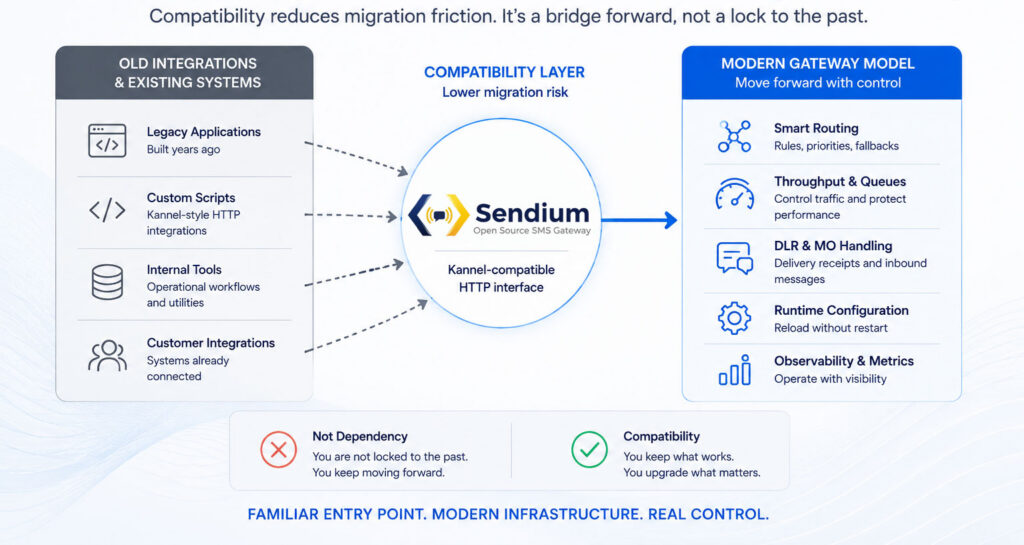
There is an important distinction between supporting an older pattern and being limited by it.
Compatibility means that existing integrations can continue to work, or can be migrated with less friction. Dependency means that the system is trapped inside the assumptions of the older model.
Those are not the same thing.
A gateway can support a Kannel-compatible HTTP submission pattern while still being built around a more modern architecture. It can accept familiar requests, but route them through a different internal model. It can preserve a known entry point while improving deployment, routing, configuration, throughput handling and operational behavior behind the scenes.
That is the right way to think about compatibility.
It is not about keeping the entire old stack alive forever. It is about giving operators and developers a safer bridge into a better one.
Why Kannel-Style Integrations Still Matter
There are many reasons why Kannel-style integrations may still exist in SMS environments.
Some teams built internal tooling around them.
Some customers already know how to use them.
Some platforms have old but stable workflows.
Some companies use them as a simple HTTP entry point into more complex messaging logic.
Some migrations have to happen gradually because the risk of disruption is too high.
In those cases, telling a team to “just rewrite everything” is not a serious migration strategy.
A better approach is to preserve what is useful at the edge, while modernizing what happens inside the gateway.
For example, an application may continue submitting messages through a familiar HTTP interface. But once the message enters the gateway, it can be normalized, routed, controlled, monitored and delivered through a more modern operating model.
That is where compatibility becomes useful.
It lets the application side remain stable while the infrastructure side evolves.
Migration Should Reduce Risk, Not Create It
In SMS infrastructure, migration risk is not abstract.
If a migration breaks message submission, OTPs may fail. Alerts may not be delivered. Customer notifications may stop. Enterprise workflows may be interrupted. Support teams may receive complaints before the technical team has even finished diagnosing the issue.
This is why a gateway migration should not be treated like a simple software upgrade.
It is an operational transition.
Compatibility helps reduce that risk because it allows teams to move in stages. They can keep existing submission patterns where needed, test new routing logic, validate provider behavior, observe delivery receipts, and gradually move more traffic through the new system.
This approach is especially important for teams with mixed environments.
A company may have modern applications using HTTP APIs, older internal systems using Kannel-style submission, downstream customers using SMPP, and upstream providers requiring SMPP connectivity. The gateway has to support the reality of the platform, not an idealized version of it.
A good migration path respects that.
Modernization Happens Behind the Interface
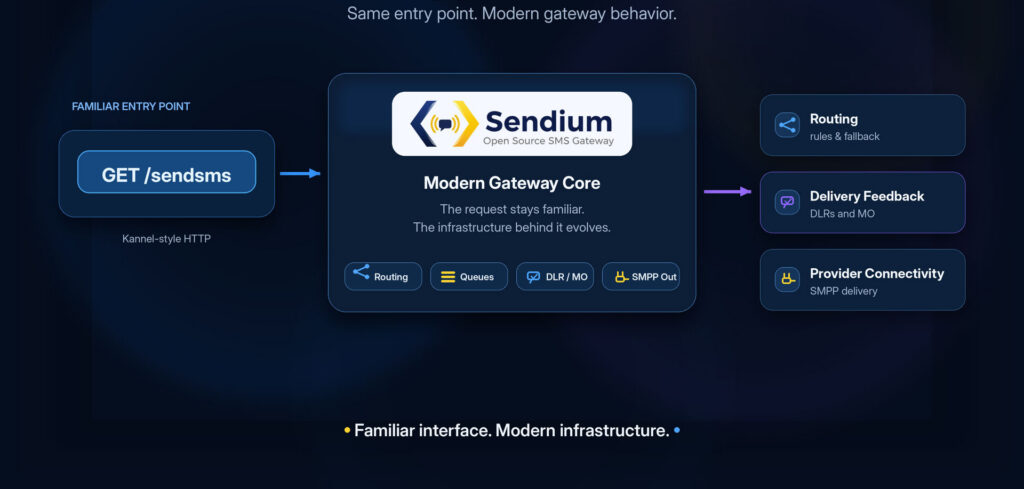
One of the strongest arguments for compatibility is that the interface is not the whole system.
A familiar API endpoint does not mean the entire architecture is old. The real modernization may happen behind that endpoint.
This can include better routing logic, configurable routing tables, throughput control, queue behavior, retry handling, delivery receipt correlation, mobile-originated forwarding, runtime configuration reloads, container-based deployment and better operational signals.
In other words, the external interface may remain familiar, while the internal gateway model becomes more capable.
That is a practical form of modernization.
It does not ask every application to change before the infrastructure can improve. It allows the gateway layer to evolve first, while giving the rest of the environment time to adapt.
Why This Matters for Operators
For operators, compatibility is about control.
If a gateway supports familiar submission patterns, operators can introduce it into existing environments with less disruption. They can test traffic flows, compare behavior, validate routing, and gradually decide which parts of the infrastructure should move next.
This is not only a technical advantage. It is an operational one.
It gives teams options.
They can run controlled tests instead of high-risk cutovers.
They can support existing customers while preparing newer integration paths.
They can modernize the gateway layer without forcing every dependent system to change at the same time.
They can avoid turning migration into a single all-or-nothing event.
That matters because SMS infrastructure often supports business-critical workflows.
A gateway that reduces migration pressure gives operators more room to make good decisions.
Why This Matters for Developers
For developers, compatibility lowers the barrier to adoption.
If a developer has worked with Kannel-style HTTP submission before, a compatible interface provides a familiar starting point. They can understand the request pattern quickly and focus on what the new gateway adds: routing behavior, provider connectivity, delivery feedback, configuration and operational control.
At the same time, modern developers do not want to be locked into old assumptions.
They want documentation, predictable behavior, testability, API discovery, containerized deployment and clean integration patterns. Compatibility should not prevent any of that.
The best approach is not to choose between familiarity and modernization.
It is to provide familiarity at the entry point and modernization in the gateway model.
Sendium’s Approach
Sendium supports this idea.
It provides a Kannel-compatible HTTP GET /sendsms submission path, but it is not designed as a simple recreation of an older gateway model. Its purpose is to provide a modern, open-source SMS gateway layer that can connect HTTP applications and SMPP clients with upstream SMPP providers, while giving operators control over routing, throughput, delivery receipts and operational behavior.
That distinction matters.
The Kannel-compatible interface helps reduce friction for teams that already understand or depend on that pattern. But the value of Sendium is not limited to that interface.
The value is what happens after the message enters the gateway.
Messages can be routed through configurable rules. Traffic can be shaped through throughput and queue control. Delivery receipts can be correlated and returned to originating systems. Mobile-originated messages can be forwarded to HTTP endpoints. Configuration can be handled in a way that is more aligned with modern operations.
So compatibility becomes the entry point.
The gateway model is the modernization.
Compatibility Is a Strategy for Adoption
In open-source infrastructure, adoption matters.
A project may be technically strong, but if it is difficult to test, difficult to integrate, or too disruptive to introduce into existing systems, many teams will never get far enough to evaluate it properly.
Compatibility helps with that first step.
It allows operators and developers to approach the project from a known place. They do not have to understand every architectural decision before sending a first test message, nor to redesign every integration before exploring the gateway.
That first successful test matters.
From there, teams can explore deeper capabilities: routing, fallback behavior, throughput management, DLR handling, MO forwarding, deployment options and contribution opportunities.
This is one reason compatibility is not only technical. It is also strategic.
It helps the project meet the market where it is.
Moving Forward Without Pretending the Past Did Not Exist
Modern infrastructure should not be built by ignoring the systems that came before it.
Kannel and similar gateway models shaped the way many teams approached SMS infrastructure. Those patterns are still present in real environments, and pretending otherwise would make modernization harder, not easier.
The better path is to acknowledge that history and build a bridge forward.
That is what Kannel compatibility should mean in a modern gateway context.
Not nostalgia.
Not technical limitation.
Not a refusal to evolve.
It means giving existing systems a practical way to connect with a newer operating model.
For teams running SMS infrastructure, that can make all the difference. Because the goal is not to win an argument about old versus new.
The goal is to modernize without unnecessary disruption.
That is why Kannel-compatible does not mean legacy thinking.
It means respecting the reality of existing SMS infrastructure while giving teams a better way to move beyond it.