


Table of Contents
SMS gateway configuration changes are part of everyday work.
A new provider is added. A route needs to be adjusted. Throughput limits have to change. A customer gets moved to another connection. A destination range starts behaving differently. A cost rule, retry rule or delivery path needs to be updated because the old assumption no longer matches what is happening in production.
Even delivery receipts can expose situations where configuration assumptions need to change, especially when message outcomes no longer match the expected behavior of a route, provider or destination.
None of this is unusual.
The problem starts when every meaningful configuration change requires a full gateway restart.
For small, controlled environments, restarting a service may not feel like a major issue. There is a maintenance window, the change is prepared, the service comes back, and everyone moves on. But SMS infrastructure does not always behave like that. Traffic may be constant. Customers may depend on the gateway in real time. Provider connections may take time to re-establish. Queues may already be under pressure. A restart may be technically simple and operationally expensive at the same time.
A modern SMS gateway should make a distinction between changes that truly require a restart and changes that should be applied while the system continues running.
That distinction matters.
Configuration Is Not a Rare Event
SMS gateway configuration is sometimes treated as something static: define the providers, set the routes, configure throughput, start the service and leave it alone.
That may be true on paper, but it is not how real messaging environments work.
Operators adjust routing because provider quality changes. They tune TPS limits because downstream capacity is different from what was expected. They add customers, remove customers, test new connections, react to incidents, shift traffic away from a problematic path, or update forwarding behavior because an application endpoint has changed.
The gateway sits in the middle of all that movement.
When SMS gateway configuration is treated as frozen, every change becomes heavier than it needs to be. Teams become cautious, not because the change is complex, but because applying it may interrupt the service. The result is a strange operational compromise: the team knows what should be changed, but waits longer than it should because the gateway cannot adapt cleanly while running.
That is not a good place for SMS infrastructure to be.
Restarts Create Operational Risk
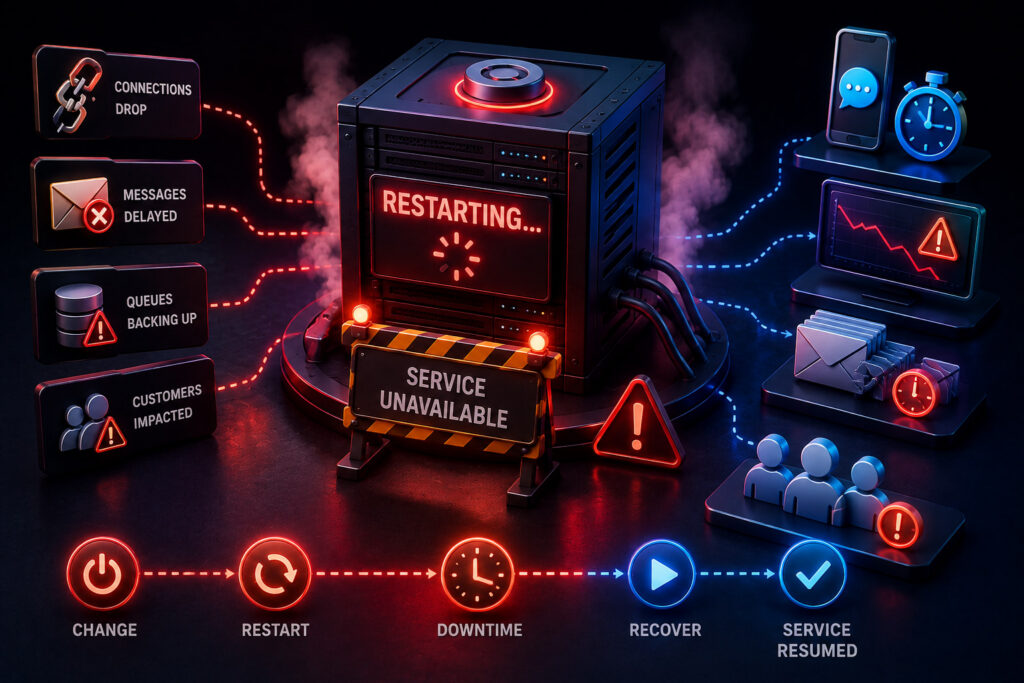
Changing SMS gateway configuration through a restart is not only a technical action. It is an operational event.
The gateway may have active provider sessions. It may be handling submitted messages, waiting for delivery receipts, managing queues or forwarding inbound traffic. It may also be serving multiple customers at the same time, each with different traffic patterns and expectations.
A restart interrupts that state.
Even if the service comes back quickly, the interruption can still create noise. Connections have to be re-established. Traffic has to resume. Queues may need to recover. Monitoring may show temporary errors. Customers may notice a delay, or worse, ask why messages stopped moving during a change that looked minor from the outside.
This is why the phrase “just restart it” is dangerous in gateway operations.
A restart may be acceptable when deploying a new binary, changing a low-level protocol component or applying a structural change that genuinely cannot be loaded safely at runtime. But it should not be the default answer for every route adjustment, limit change or customer configuration update.
The gateway should help operators reduce avoidable interruptions, not turn routine changes into service events.
Routing Decisions Change in Production
Routing is one of the clearest examples.
A route that was good yesterday may not be the best route today. A provider may start returning more failures. Latency may increase. A connection may become unavailable. A destination may require a different path because of cost, quality or delivery behavior. A customer may need a temporary override while an issue is investigated.
This is also where fallback routing becomes part of the operational picture, because route decisions often need to change when provider behavior, delivery quality or connection availability changes in production.
These are not always planned changes.
Sometimes the team has to react while traffic is already moving.
If every routing update requires a restart, the operator is forced to choose between two bad options: leave traffic on a weaker path for longer, or restart the gateway and accept the operational disruption. In both cases, the gateway is making the response slower than it needs to be.
Runtime SMS gateway configuration changes do not magically solve routing strategy. They do not replace monitoring, provider testing or good operational judgment. But they do give teams a safer way to apply decisions when the situation changes.
That is the important part.
The gateway should not only know how to route traffic. It should also make routing adjustments practical when production conditions change.
Throughput Limits Need Flexibility
Throughput control is another area where restart-heavy configuration becomes a problem.
Throughput is not just a performance setting. It is part of how SMS traffic is controlled. A gateway may need to respect provider limits, protect downstream systems, separate customer capacity or reduce pressure during incidents.
Those limits may need to change.
A provider may increase the allowed throughput. A customer may need temporary capacity for an expected traffic spike. A route may need to be slowed down because delivery behavior has degraded. A queue may be building faster than expected, and the team may need to rebalance traffic before the problem becomes larger.
When TPS changes require a restart, the team loses a useful operational lever.
The safer model is to let operators adjust relevant SMS gateway configuration without stopping the gateway, as long as the change can be applied safely and consistently.
That gives the team more control over pressure without creating an additional interruption at the moment they are trying to stabilize the system.
In production, control often matters more than theoretical maximum speed.
Not Every Change Should Be Live
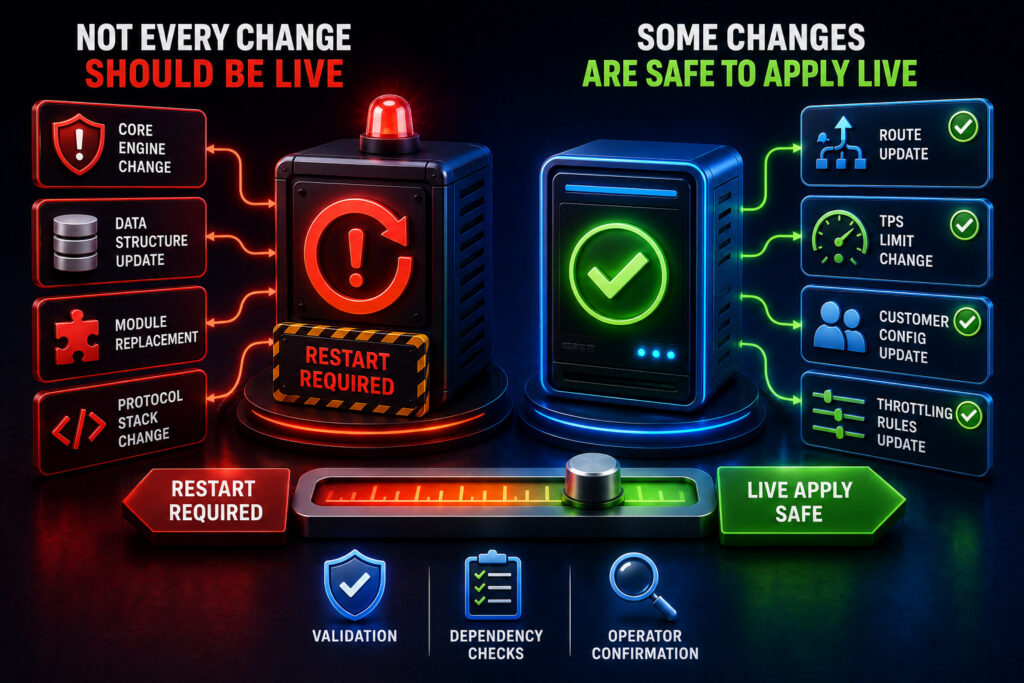
There is an important caveat here.
Runtime SMS gateway configuration is not the same as careless configuration.
A gateway should not accept every possible change blindly while running. Some changes may affect internal state too deeply. Others may need validation, dependency checks or a controlled deployment process. There may be cases where restarting the service is still the safest option.
That is fine.
The goal is not to eliminate restarts completely. The goal is to stop treating restarts as the only way to make the gateway respond to operational reality.
A good design should separate configuration into categories.
Some settings can be safely reloaded. Some may require connection-level handling. Some may require a controlled restart. Some should probably be rejected if they are invalid or incomplete. What matters is that the system has a clear model, instead of forcing every change through the same heavy mechanism.
Live configuration only helps if operators can trust it.
That means validation, predictable behavior and enough visibility to understand whether the new configuration was accepted and applied.
Configuration Changes Need Guardrails
The more dynamic SMS gateway configuration becomes, the more important the guardrails become.
It should be possible to know which configuration version is active. It should be clear when a change was applied. Invalid rules should not silently enter production. A partial configuration should not leave traffic in an uncertain state. Operators should be able to reason about what changed and what effect it had.
This is where runtime configuration becomes an operational discipline, not just a convenience feature.
Without guardrails, live changes can create a different kind of risk. A team may avoid restarts, but introduce confusion. Routes may behave differently from what the operator expected. A small mistake may affect live traffic immediately. A change may be hard to trace later when someone asks why a message moved through a certain path.
So the point is not simply “reload without restarting”.
The point is controlled change.
A modern SMS gateway should make configuration updates safer, clearer and easier to operate. Not more mysterious.
Why This Matters for Open Infrastructure
Open-source SMS infrastructure has always been valuable because it gives operators control.
But control should not only mean access to the code or the ability to edit a configuration file. It should also mean being able to operate the gateway in a way that matches production needs.
If the only practical way to apply important changes is to restart the service, then part of that control is still missing.
Modern infrastructure is expected to adapt. Cloud systems, containerized deployments, automated operations and customer-facing platforms all push teams toward faster, more controlled change. SMS gateways do not live outside that reality. They may speak telecom protocols such as the SMPP protocol, but they still have to fit into modern operational environments.
For teams coming from older gateway models, this is one of the areas where modernization becomes very tangible.
Not as a marketing slogan.
As a daily improvement in how SMS gateway configuration is managed in production.
Changing a route should not always feel like a deployment. Adjusting a limit should not always require a maintenance window. Updating a customer-facing path should not always interrupt unrelated traffic.
The gateway should give operators a better way to apply change.
Where Sendium Fits
Sendium is designed with the idea that SMS gateway infrastructure should be more adaptable than the older restart-heavy model many teams are used to.
That includes live SMS gateway configuration behavior where it makes sense.
Developers and operators can explore Sendium on GitHub to see how the project approaches open SMS gateway infrastructure and ongoing development.
In practical terms, this means treating the gateway as an operational control layer, not just a process that reads a static configuration at startup and then needs to be restarted whenever production reality changes. Routes, limits and gateway behavior should be manageable in a way that reduces avoidable disruption and gives operators more room to react.
This does not mean every possible change should be applied live. It means the gateway should be designed with a more realistic understanding of how SMS teams work.
Production environments change.
Provider behavior changes. Customer requirements change. Traffic pressure changes. Operational priorities change.
The gateway should not be the slowest part of the response.
A restart will sometimes be necessary. But it should not be the default answer to every configuration update.
Modern SMS infrastructure needs a more practical model: one where the gateway can keep running, operators can apply controlled changes, and the platform can adapt without turning every adjustment into an interruption.