

Table of Contents
SMS is not outdated. But the infrastructure around it often is
SMS is not outdated. But the infrastructure around it often is
For years, people have predicted the decline of SMS.
And yet, SMS remains one of the most widely used communication channels for business-critical messaging.
It is still used for authentication.
It still powers OTP flows.
It still delivers alerts, reminders, operational updates, financial notifications, logistics messages, and high-volume A2P communication.
In many industries, SMS is not just “another channel.”
It is infrastructure.
But while the role of SMS has expanded, the systems behind it have not always evolved at the same pace.
Many organizations now operate modern applications, cloud-native services, APIs, automation platforms, analytics tools, and real-time business systems — while still relying on messaging infrastructure that was designed for a much simpler era.
That mismatch creates a problem.
Not because SMS no longer works.
But because the infrastructure around SMS often lacks the control, visibility, flexibility, and openness that modern teams now expect.
The expectations around messaging have changed
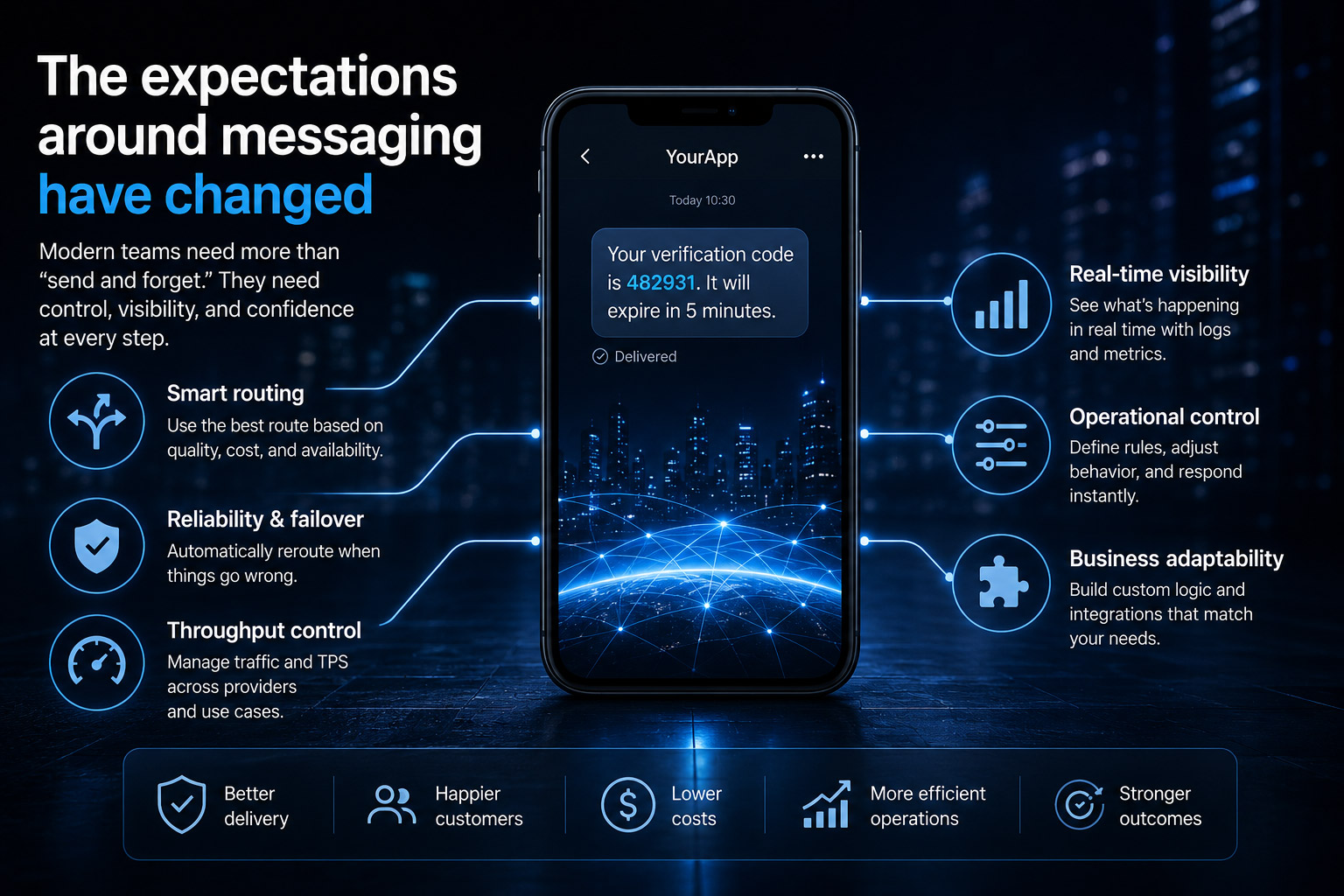
In the past, sending an SMS was often treated as a simple technical action:
An application generated a message.
The gateway accepted it.
The provider delivered it.
The process was considered complete.
Today, that view is no longer enough.
Messaging teams need to understand what happens before, during, and after a message leaves their system.
They need answers to questions like:
- Which route should this message use?
- What happens if a provider becomes unstable?
- Can traffic be rerouted automatically?
- Can throughput be controlled per connection or provider?
- Can routing rules change without downtime?
- Can logs, metrics, and delivery behavior be inspected clearly?
- Can the gateway adapt to business-specific logic?
- Can the infrastructure scale without becoming harder to manage?
These are not edge cases.
They are everyday operational requirements for modern SMS environments.
As traffic volumes grow and messaging use cases become more complex, the gateway becomes more than a connector. It becomes the layer where reliability, cost efficiency, routing strategy, and operational control are decided.
SMS infrastructure needs to move from forwarding to control
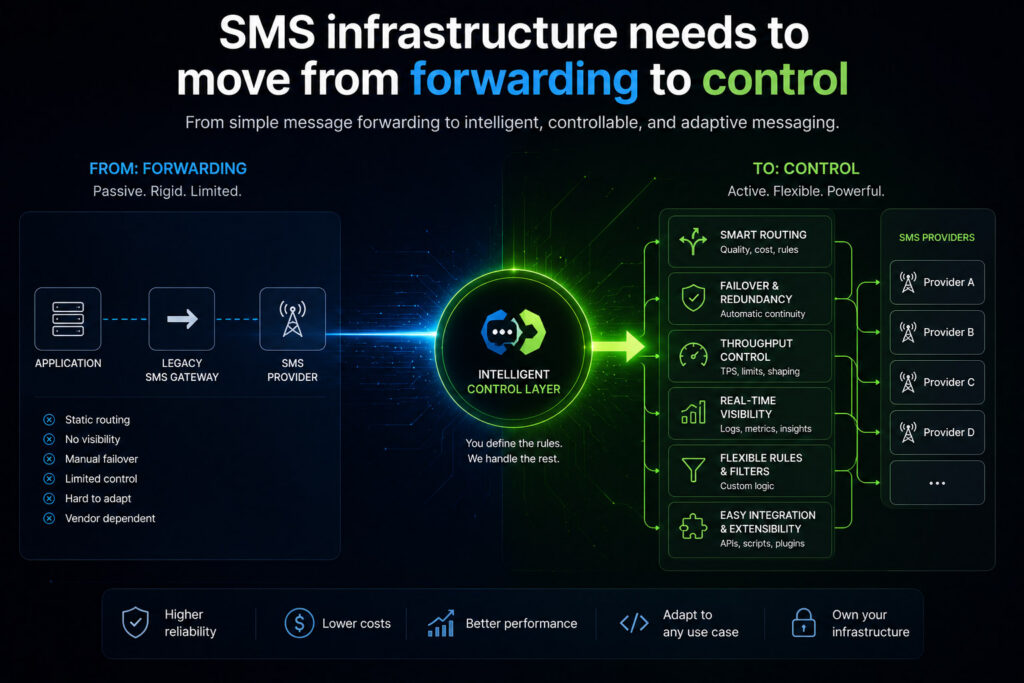
A basic SMS gateway forwards messages.
A modern SMS infrastructure layer helps teams control how messages move.
That distinction matters.
Forwarding is passive.
Control is active.
Forwarding means the gateway accepts traffic and passes it along.
Control means the gateway helps decide how that traffic should be handled based on rules, routes, limits, provider behavior, and operational priorities.
In modern messaging environments, teams need control over:
Routing
Messages should be able to follow routes based on destination, provider availability, traffic type, cost, quality, or custom business logic.
Failover
If a route or provider becomes unreliable, the system should help maintain continuity instead of leaving teams to react manually.
Throughput
TPS limits and traffic shaping should be manageable across connections, providers, and use cases.
Visibility
Teams should be able to inspect what is happening inside the messaging layer, not operate blindly.
Configuration
Infrastructure should be adaptable without unnecessary restarts, delays, or operational disruption.
Extensibility
Every business has different requirements. Messaging infrastructure should support custom rules, filters, integrations, and vendor-specific logic.
This is where SMS infrastructure needs to evolve: from simple message forwarding to intelligent, controllable, observable message handling.
Legacy infrastructure creates operational drag
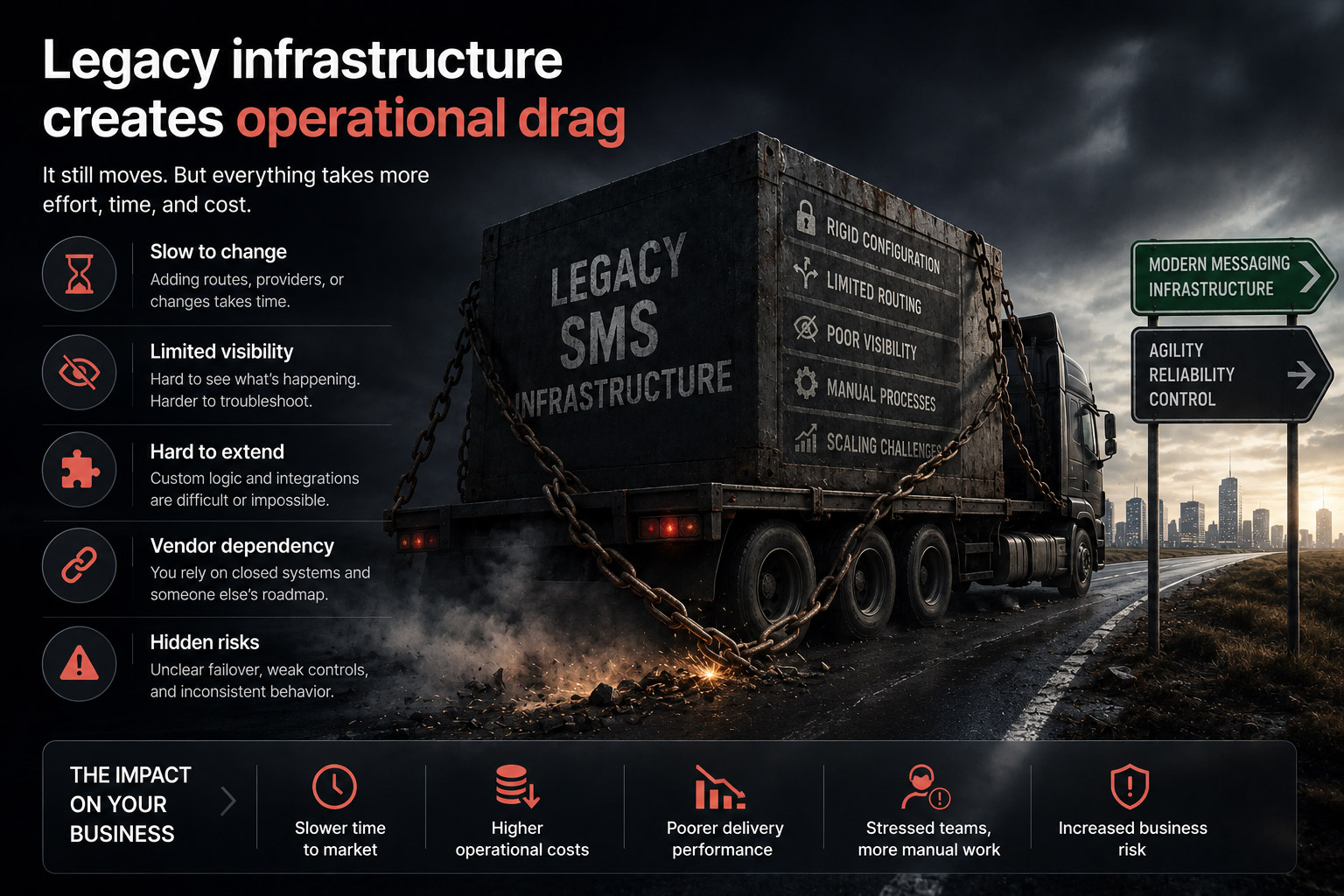
Legacy systems often continue to work — until something changes.
A new provider needs to be added.
Traffic volume increases.
Delivery quality drops.
A route becomes unstable.
A customer needs custom logic.
Compliance requirements change.
A team needs better reporting.
A business needs to scale.
This is when older infrastructure starts creating friction.
The issue is not always a total failure. More often, it is operational drag.
Small delays.
Manual workarounds.
Limited visibility.
Rigid configuration.
Slow changes.
Difficult debugging.
Vendor dependency.
Unclear routing behavior.
Over time, these issues become expensive.
They slow down teams.
They reduce confidence.
They make scaling harder.
They increase dependency on closed systems.
They limit how much control businesses have over their own messaging operations.
For companies that depend on SMS for authentication, customer communication, alerts, or high-volume messaging, this is not just a technical limitation.
It is a business risk.
Messaging infrastructure should not be a black box
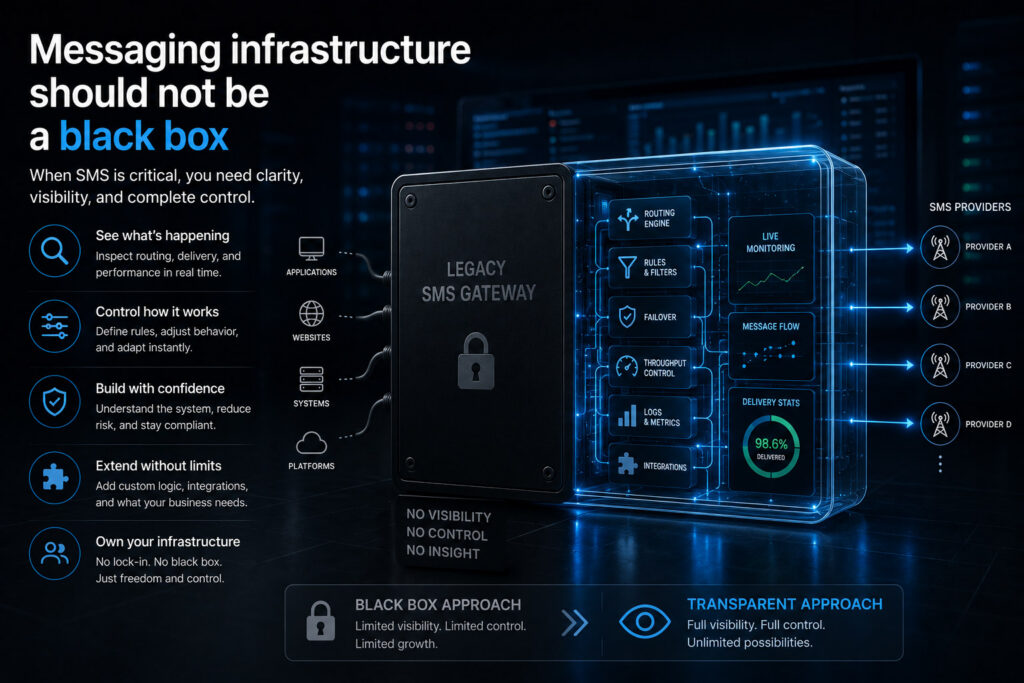
When SMS is used for critical communication, teams need to understand and control the systems behind it.
A black-box gateway may be convenient at first, but it creates long-term limitations.
If you cannot see how routing decisions are made, troubleshooting becomes harder.
If you cannot adapt logic, every new requirement becomes slower to implement.
If you cannot extend the system, your business must adapt to the tool instead of the tool adapting to your business.
If you cannot control your infrastructure, you become dependent on someone else’s architecture.
Modern messaging infrastructure should provide transparency.
Teams should be able to inspect behavior, define logic, adjust routing, monitor performance, and understand how traffic moves through the system.
That visibility is not just useful for developers.
It matters for operations, compliance, customer experience, cost control, and business continuity.
Openness is becoming a strategic advantage

As messaging infrastructure becomes more important, openness becomes more valuable.
Open systems allow teams to understand how the infrastructure works.
They make it easier to extend and adapt.
They reduce dependency on closed vendor ecosystems.
They support collaboration, contribution, and long-term improvement.
For SMS gateways, open infrastructure can help teams move away from rigid, black-box systems and toward platforms that are transparent, flexible, and built around ownership.
This matters especially in telecom and messaging environments, where requirements vary widely.
Different providers behave differently.
Different routes perform differently.
Different businesses need different logic.
Different deployments require different levels of control.
A one-size-fits-all approach does not always work.
Modern SMS infrastructure needs to be flexible enough to support real-world complexity.
What modern SMS infrastructure should look like
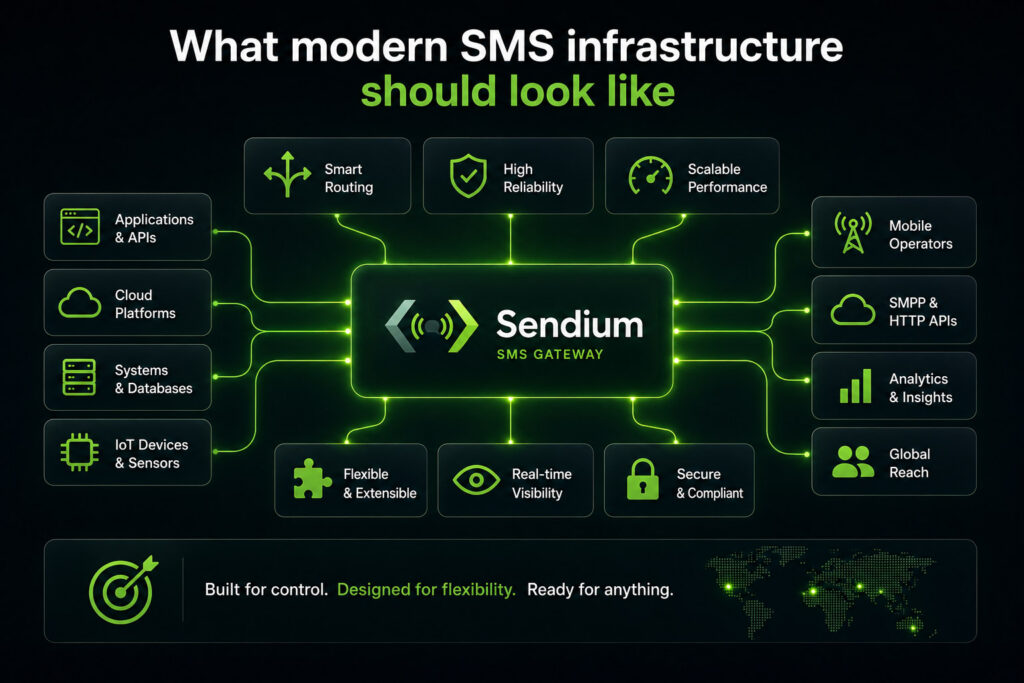
A modern SMS infrastructure layer should be built around control, visibility, and adaptability.
It should support protocol flexibility, including SMPP and HTTP-based integrations.
It should allow routing logic to be defined and adjusted based on operational needs.
It should support failover and provider management.
It should give teams control over throughput and traffic behavior.
It should provide logging, metrics, and visibility into message flow.
It should support cloud-native, on-premise, or hybrid deployment models.
It should be extensible enough to support custom filters, routing rules, integrations, and vendor-specific requirements.
And most importantly, it should give teams ownership over the messaging layer they depend on.
Because the future of SMS infrastructure is not just about sending more messages.
It is about sending them with more control, more transparency, and more confidence.
This is why Sendium is being built
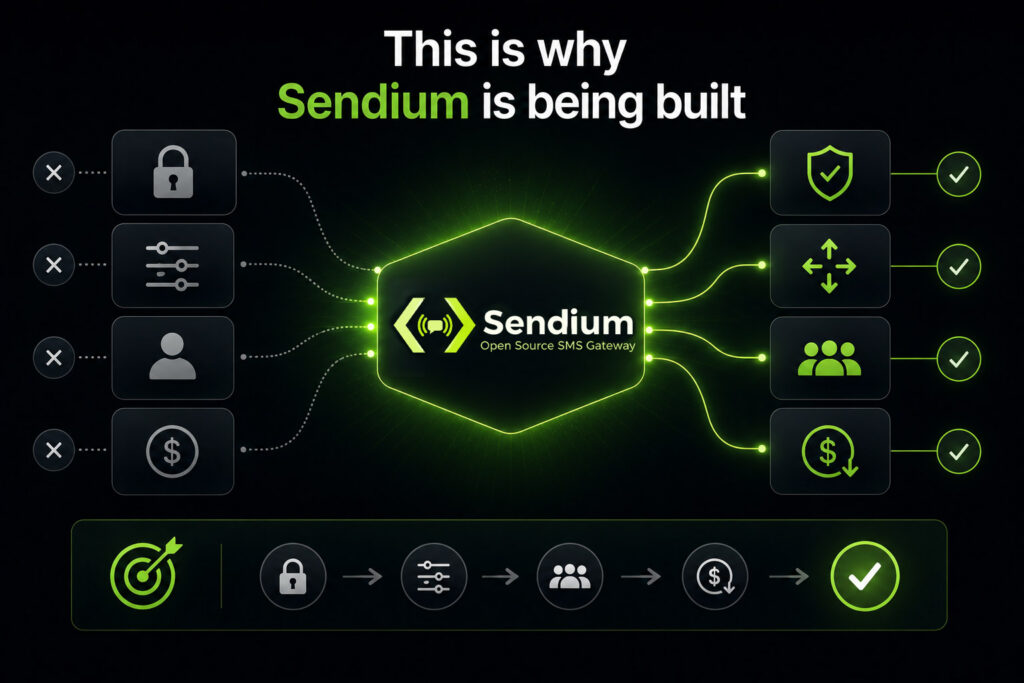
Sendium is an open source, headless SMS gateway built for teams that want more control over their messaging infrastructure.
It is designed to sit between applications and SMS connectivity, helping teams manage how messages move before they leave the system.
With support for SMPP server and client capabilities, HTTP/SMPP bridging, routing logic, TPS control, failover handling, live reconfiguration, and extensible architecture, Sendium is being built for modern messaging environments where flexibility and ownership matter.
The goal is simple:
To give developers, telecom professionals, CPaaS teams, and businesses a more open and controllable way to operate SMS gateway infrastructure.
Not a black box.
Not a rigid legacy layer.
Not a system that holds the stack back.
But an open infrastructure layer built for control.
SMS still matters. The infrastructure must catch up.

SMS continues to play a critical role in digital communication.
It connects systems to people.
It supports authentication.
It delivers urgent information.
It powers business-critical workflows across industries.
But the infrastructure behind SMS must evolve.
Modern teams need more than message forwarding.
They need routing control.
They need visibility.
They need failover.
They need scalability.
They need extensibility.
They need freedom from unnecessary lock-in.
The future of SMS is not about replacing the channel.
It is about modernizing the infrastructure behind it.
Sendium launches on May 31.

Open source SMS gateway infrastructure, built for control.