

Table of Contents
SMS infrastructure is one of those technologies that many businesses depend on every day, but rarely stop to question.
As long as messages are sent, One-time passwords arrive, systems remain connected to providers and internal applications, the infrastructure behind them often stays invisible. Until something breaks.
When messages stop being delivered or delivery delays significantly, or even a new integration with the system is required, then the SMS gateway is no longer just a background component. It becomes a critical part of the business.
And that is where the question becomes important: Who really controls your messaging infrastructure?
The SMS Gateway Is More Than a Connector
For many organizations, an SMS gateway is still treated as a simple bridge between an application and the SMS world. It receives a message from one side and pushes it to another.
But in modern messaging environments, that definition is no longer enough.
A proper SMS gateway is part of the operational core. It affects performance, reliability, compliance, flexibility, and inevitably profitability. It determines how traffic flows, how failures are handled, how quickly teams can react, and how much visibility they have into what is really happening.
In high-volume or business-critical environments, the gateway is not just a connector, but core infrastructure, and it cannot be a black box.
The Problem With Black-Box Messaging Infrastructure

Many companies rely on closed, proprietary SMS gateway solutions. These systems may work well for certain use cases, especially when the requirements are simple or when a business prefers a fully managed environment.
But closed systems often come with limitations on customization, configuration, optimization and business independence.
Over time, this creates high dependency and ultimately constraint.
The more a messaging operation grows, the more specific the requirements become. More control over routing,better visibility into failures, ability toadapt to different upstream providers, independentthroughput management becomes paramount. Each organisation needs to deploy in a way that fits its infrastructure, not someone else’s assumptions or business model.
If the gateway is closed, every new requirement can become a negotiation.On the other hand, if the gateway is open, it becomes an engineering decision.
Open Source Means Control

Open source matters because it gives technical teams ownership. It allows them to understand the technology they depend on. They can inspect it, test it, adapt it, extend it, and deploy it according to their own needs.
This is especially important in SMS infrastructure, where every environment is different.
One company may need a cloud-native deployment. Another may require on-premise infrastructure for regulatory or operational reasons. In the same way, all aspects of technical and business decisions behind the SMS infrastructure of a company should be controlled and managed by the company itself.
There is no single “perfect” gateway configuration for everyone.
Open source allows the gateway to become flexible enough for real-world use cases instead of forcing every organization into the same predefined model.
Transparency Builds Trust
In messaging, trust is not just a marketing word. It is operational.
Businesses need to know how their traffic is handled, how the system behaves, how to diagnose issues quickly,and how their critical infrastructure can be reviewed, audited, and improved.
With open-source infrastructure, transparency is built into the model.
The code can be inspected and the architecture can be understood. This does not automatically mean that every deployment is secure or well-managed, but it does mean that the foundation is visible.
That visibility matters because It helps teams make informed decisions without blind dependency. It makes troubleshooting more practical and It allows the community to identify issues, suggest improvements, and contribute to the long-term maturity of the project.
For SMS gateways, where reliability and trust are essential, transparency is not a luxury but an irreplaceable part of the infrastructure’s value.
Open Source Does Not Mean “Do It Alone”
One common misunderstanding is that open source means teams are left on their own.
However, that is not the point.
Good open-source infrastructure does not remove the need for expertise, support, planning, documentation, or responsible deployment. In fact, it often makes those things more important.
The difference is that open source gives organizations options. They can run the gateway internally, but the community can and will improve it over time. Commercial services, support, hosting, consulting, and managed options can still exist around the project.
Open source is not the absence of structure But the presence of freedom in an organised way.
Avoiding Vendor Lock-In
Vendor lock-in is one of the biggest long-term risks in infrastructure decisions.
At first, a closed solution may seem convenient. It solves the immediate problem. It gets the business moving very quickly and it provides a clear interface and a pre-defined support model.
Having said that, as requirements evolve, the cost of dependency increases. Customizations, feature additions and modifications become expensive both in time and money.
Migration is a solution but includes increased cost and complexity, risking customer satisfactions and service continuity.
Open-source SMS gateways reduces this risk exponentially. They allow organizations to keep more control over their architecture, deployment model, and future roadmap. Adapting to new needs and market developments does not disrupt the business/
In the long term, that flexibility is strategic, Open Source means your infrastructure can evolve with you.
Community-Driven Development Matters
Open source is not only about code. It is also about community.
A strong community brings together different perspectives. People from different disciplines and backgrounds offer their own perspective, use-cases, and operational needs.
That diversity is what improves the project. The community helps identify bugs, propose features, improve documentation, test deployments, and challenge assumptions. It can turn a product into an ecosystem.
For an SMS gateway, this is especially valuable because messaging infrastructure lives in a complex environment of different markets, regulations, traffic patterns, and technical requirements. All these shape how the gateway needs to behave and evolve.
A community-driven gateway can learn from those realities faster than a closed system that only evolves according to a single vendor roadmap.
Why This Matters Now
SMS is not new, but the way businesses use messaging continues to evolve.
Modern applications are built differently than 20 years ago and organizations have different needs around SMS. SMS has become in many cases mission critical and is not just a marketing tool anymore. This has created the business need for an adaptable, resilient, visible, and flexible SMS gateway.
At the same time, most existing gateway solutions were designed for a different era.
Some are powerful but difficult to modernize and others are convenient but too closed.
This created a clear need for a new generation of SMS gateway infrastructure that is open, transparent, extensible, and built for modern deployment models.
That is where the idea for Sendium was born and evolved.
Sendium: Open Source SMS Gateway Infrastructure
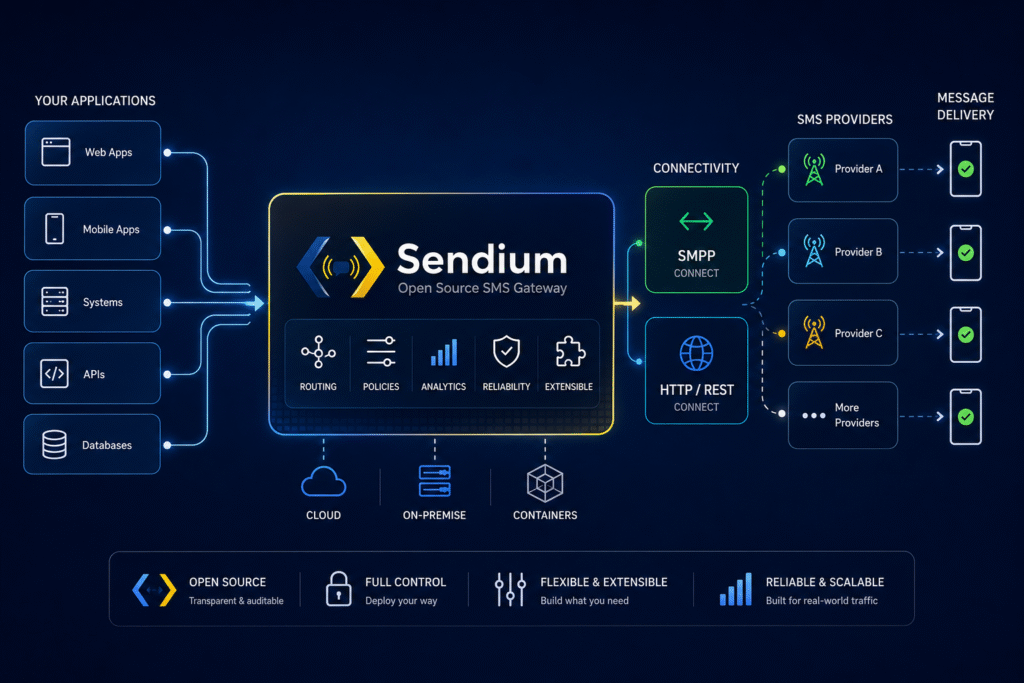
Sendium was created with a clear belief:
Messaging infrastructure should be open, controllable, and built for the people who actually use it.
As an open-source, headless SMS gateway, Sendium is designed to sit between applications and SMS connectivity, helping teams manage how messages enter, move through, and leave their infrastructure.
It is built for everyone that owns a system that needs to send and receive SMS messages. It is for those that want visibility, flexibility, and control over their messaging stack.
Sendium focuses on the practical realities of SMS infrastructure: HTTP and SMPP connectivity, routing control, extensibility, deployment flexibility, and the ability to adapt to different operational needs.
The goal is not simply to send messages, but to give teams ownership of the gateway layer.
Open Infrastructure for a Practical Future
Open source does not magically solve every infrastructure challenge. A gateway still needs proper configuration, monitoring, security practices, operational discipline, and technical expertise.
But open source changes the starting point.
Instead of asking, “What does the vendor allow us to do?” teams can ask, “What do we need the infrastructure to do?”
That is a very different conversation and approach.
For SMS gateways, this difference matters, as It affects how companies scale,troubleshoot, integrate, control costs, manage providers, and prepare for the future.
The future of messaging infrastructure should not be closed, rigid, or hidden.
It should be open enough to understand, flexible enough to adapt, and strong enough to support real-world messaging operations.
That is why open source matters.. and that is why Sendium exists.