
Table of Contents
1) Introduction
My name is Dimitris Petrakis, and I am the Community Manager for Sendium Open Source SMS Gateway at Cytech Mobile. My background is in community building, social media management, digital communication, and audience engagement across both technical and non-technical sectors.
I enjoy acting as a bridge between a product and its community: understanding user needs, encouraging meaningful interaction, and helping turn feedback into something practical and valuable.
I joined Cytech Mobile in October 2025 to help build and manage the community around Sendium, with a focus on growing awareness, engaging professionals and potential users, and encouraging participation from an early stage.
What excites me most about Sendium is the combination of real-world technology and the open-source values of collaboration, transparency, and continuous improvement.
With the right SMS gateway architecture, control is not about pretending the outside world is predictable. It is about making sure that your own handling, routing logic, observability, and partner selection are not the weak point.
That is where modern infrastructure makes the difference.
2) What is Sendium and what does its name mean?
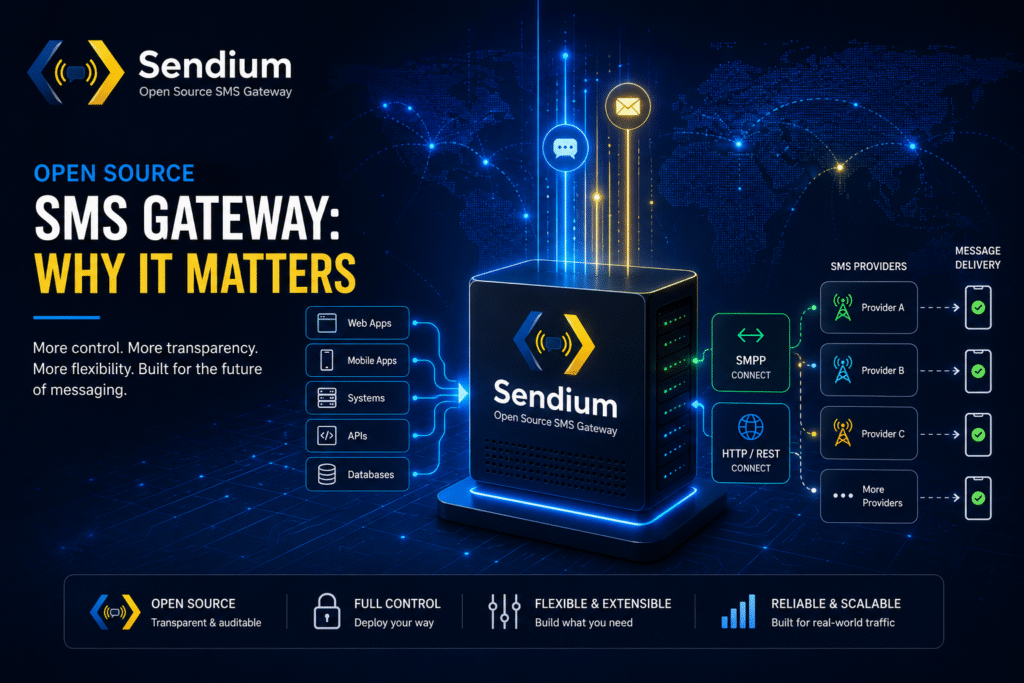
Sendium is an open-source, headless SMS gateway designed for high performance and modern infrastructure environments. It sits between a company’s internal systems—such as CRMs, websites, or IoT platforms—and SMS providers, giving businesses significantly greater control over their messaging infrastructure.
In simple terms, it enables routing, failover, real-time DLR management, granular TPS control, and protocol translation between HTTP and SMPP—without vendor lock-in.
The name Sendium is inspired, obviously, by the “Sending” of messages but also by the latin suffix -ium that in some cases means “a place where an activity occurs”. So, Sendium is a “place” where the activity of sending messages occurs.
3) Who is it for?
Sendium is built for organizations and technical teams that require serious control, flexibility, and transparency in SMS messaging.
This includes a variety of individuals and companies. Clearly we have the messaging companies that are either aggregators and messaging hubs managing traffic across multiple upstream carriers, as well as SMS providers that offer SMS services to enterprises for marketing and any type of communication with their clients.
Furthermore, we have the enterprises sending critical OTPs, alerts, and transactional notifications, that need to keep the control over SMS routing and deliverability. Increasingly, there are also IoT/M2M use cases where SMS remains critical when stable data connectivity is not available. Last but not least are the individual software developers and development teams that want to incorporate SMS sending to their projects. Notably, these are usually the most important contributors and participants in Open Source communities.
Generally, Sendium is highly relevant for companies and individuals that want to keep the gateway layer under their control either on-premise or on-cloud for reasons of security , compliance and internal policy.
4) What does it offer to the market and how is it different?
Sendium’s key differentiation is that it brings two worlds together. One one hand, it is a gateway based in modern technologies that is comparable in capabilities to proprietary solutions. On the other hand, Sendium is an open source software, giving everyone the opportunity to deploy and use it, taking advantage of its modern features and the transparency and control it provides.
Instead of relying on closed and rigid systems, businesses gain their own gateway layer where they can define routing rules, implement failover, monitor DLRs, control throughput, and integrate seamlessly with their existing environment.
At the same time, Sendium joins the messaging industry as a modern, container-friendly alternative to legacy solutions such as Kannel, with a roadmap that includes TLS support, Prometheus metrics, advanced rerouting, load balancing, billing-aware routing, HLR/MNP-informed routing, and future integrations like Kafka, as well as foundations for multichannel routing.
5) Why did you decide to make it open source? What was Cytech Mobile’s incentive?
We didn’t make Sendium open source for visibility or hype, but because we believe this is how modern messaging infrastructure should be built.
In critical use cases such as OTPs, alerts, and sensitive notifications, the market is increasingly demanding more transparency, greater control, and reduced dependence on closed ecosystems.
The open-source model provides visibility into the system’s logic, greater extensibility, and a lower barrier to entry for companies and innovators.
For Cytech, this approach is not new. The company already has an active presence in the open-source ecosystem, with projects and contributions, so Sendium builds on an existing philosophy rather than a temporary initiative.
Ultimately, Cytech’s incentive was to bring its real-world telecom expertise into a more open, modern, and community-driven infrastructure model.
6) What early signals do you have from the community and what is the goal?
The community is just getting started and is still in its early stages. We are essentially talking about an effort of just a couple of weeks, so it would not be accurate to present it as already mature or large-scale.
However, the goal is very clear: to create a space where the market can openly share pain points, needs, and challenges, where members can exchange insights and experiences, and where there is direct interaction with the product’s creators.
Over time, it is natural that this community will expand into more touchpoints—not only through social channels but also through additional forms of interaction.
Cytech Mobile is already inviting people to join the conversation early, through Sendium’s community channels, as the product approaches its release.
7) Tell us a few words about Cytech Mobile
Cytech Mobile is a software and telecom solutions company based in Crete, Greece, with a presence in the market since 2001, strong expertise in mobile messaging, and tailormade software solutions..
The company develops in-house solutions for demanding use cases, telecom and otherwise, and places strong emphasis on both technical excellence and security, as reflected in its ISO 27001:2022 and ISO 27701:2019 certifications.
Sendium is therefore not the result of a purely theoretical effort, but a product built on real-world experience in messaging and telecom infrastructure.
8) Why now? Why does the market need this solution today?
Timing plays a crucial role.
While SMS remains one of the most reliable and critical communication channels for OTPs, alerts, notifications, and enterprise communication to the users, the infrastructure behind it is often outdated or rigid, and opaque.
Today, businesses demand more control, better visibility, easier integrations, more modern architectures, but also cost efficiency.
This is exactly where Sendium fits in—as an open-source, headless SMS gateway that allows organizations to connect multiple providers, define routing and failover logic, control throughput and DLR handling, and deploy either on-premise or in the cloud, without vendor lock-in.
9) What does “community-driven” mean in practice for Sendium?
For us, being community-driven means not building the product in isolation.
We want to actively listen to market needs, identify real pain points, exchange knowledge with practitioners, and as the project grows, create a stronger and more direct connection between users and the people developing the product.

10) How can someone get involved before the release?
Anyone interested can already join the conversation, follow our community channels, get familiar with the product’s philosophy early on, and share their own needs, use cases, and challenges.
For us, it is important that this relationship starts before the official release—not just after.