


Blog post

What “Full Control” in an SMS Gateway Actually Means

Table of Contents

For years, many businesses treated SMS infrastructure as something that simply had to “work.”  As long as messages were sent, the system was considered good enough.

But modern messaging environments demand far more than basic delivery.

A futuristic nighttime cityscape overlaid with glowing cyan data streams flowing along highway routes. Five connected, circular icons hover above the city representing communication, security, performance, routing, and visibility, illustrating centralized network control and digital monitoring.

Today, SMS is used for critical communication: one-time passwords, alerts, customer updates, service notifications, and time-sensitive operational messages. In these environments, success is not defined only by whether a message leaves the system. It is defined by whether the team behind that system has visibility, flexibility, reliability, and control.

That is why the real question is no longer:

“Can your gateway send SMS?”

It is:

“How much control do you actually have over the way messaging works inside your infrastructure?”

SMS is not broken. Lack of control is.

When messaging operations become more complex, the problems are rarely caused by SMS itself. More often, they come from infrastructure limitations.

Teams run into issues when they cannot clearly see what is happening inside their messaging flow. They struggle when routing logic is rigid, when throughput cannot be managed properly, when integrations are difficult, or when they are forced to rely on systems that behave like black boxes.

In other words, the challenge is not the channel. The challenge is the lack of operational control behind it.

A glowing digital network overlays a nighttime cityscape, featuring a large central node labeled "SMS". Glowing blue lines connect it to peripheral icons depicting routing, search, security, and puzzle pieces, symbolizing centralized control and integration of messaging systems.

A modern SMS Gateway should do more than pass traffic from point A to point B. It should give teams the ability to shape, monitor, and optimize how messaging moves through their environment.

What “full control” actually means

Control in messaging infrastructure is not a vague idea. It has a very practical meaning.

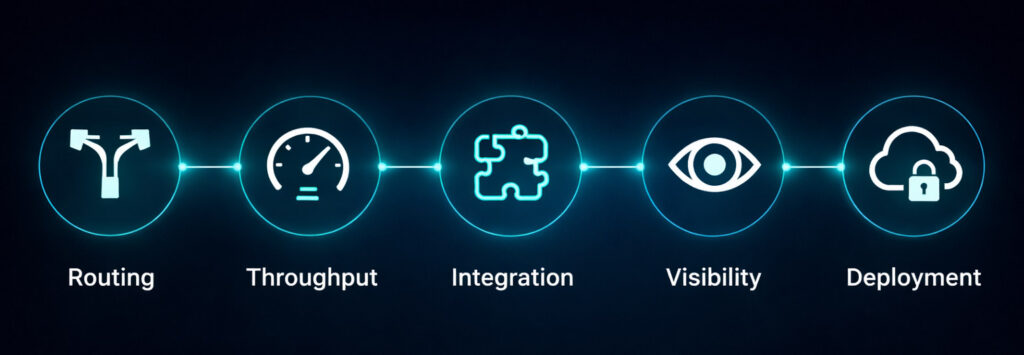
1. Control over routing

Not all traffic should be treated the same way.

Different routes may be better suited for different destinations, operators, priorities, quality requirements, or cost conditions. A gateway with flexible routing allows teams to make deliberate decisions instead of forcing all traffic through a single static path.

This matters because messaging environments are rarely one-dimensional. Businesses need the ability to adapt route behavior based on real operational needs, rather than accepting a one-size-fits-all model.

An informational graphic featuring text on the left and a conceptual illustration on the right. The text emphasizes that control is a foundational element, not just a feature. The illustration shows a dark cube acting as a "black box," taking in chaotic, tangled red and orange data streams on one side and outputting organized, parallel cyan data streams on the other.
2. Control over throughput

As messaging volume grows, throughput becomes a serious operational factor.

A modern gateway should allow teams to manage how much traffic flows through each connection and under what conditions. Throughput control is not just about speed. It is about stability, predictability, and protecting both upstream and downstream systems from overload.

When rate handling is treated as a first-class capability, messaging becomes far easier to scale responsibly.
3. Control over integration

Modern infrastructure is rarely built around a single protocol or a single system.

Some teams work with HTTP-based applications. Others rely on SMPP connectivity. Many operate in mixed environments where legacy systems and newer services must coexist. In those cases, the gateway becomes a critical translation and interoperability layer.

Control means being able to integrate systems in a way that is practical, flexible, and aligned with the architecture teams already have — rather than forcing them to redesign everything around infrastructure limitations.

4. Control over visibility

A gateway should not behave like a sealed box.

Teams need visibility into message flow, routing behavior, delivery status, queueing, retries, and connection activity. They need to understand what is happening, where traffic is going, and where issues may be developing.

Without visibility, troubleshooting becomes guesswork. With visibility, messaging becomes manageable.

This is one of the biggest differences between infrastructure that merely functions and infrastructure that can be operated with confidence.
5. Control over deployment

Different organizations have different operational and regulatory realities.

Some want cloud-native flexibility. Others require on-premise deployment because of internal policy, architecture, compliance, or performance considerations.

For many teams, true infrastructure freedom means being able to choose the deployment model that fits their environment instead of being forced into one approach. That choice is part of control.
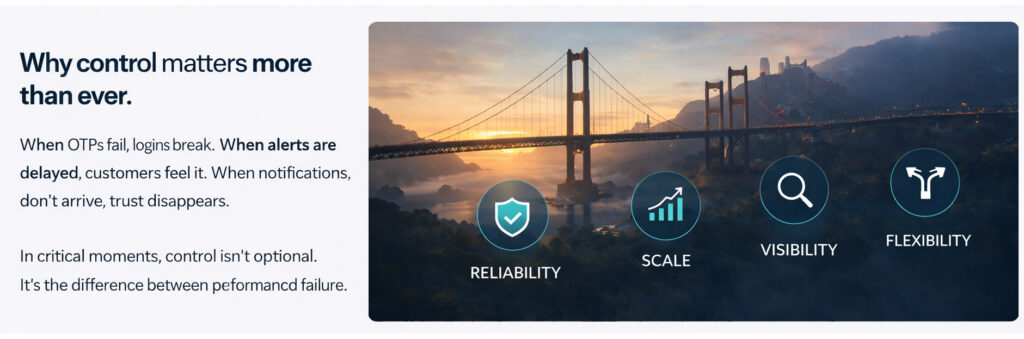
Why this matters more than ever

Messaging has become part of core business infrastructure.

When OTPs fail, users cannot log in.
When alerts are delayed, service quality suffers.
When notifications become unreliable, trust is lost.

An informational graphic explaining why system control matters more than ever, warning that lack of it leads to communication failures. The right side features a photograph of a suspension bridge at dawn, overlaid with four icons representing Reliability, Scale, Visibility, and Flexibility.

In that context, infrastructure decisions have direct business consequences. Organizations are no longer looking only for a tool that can send messages. They are looking for messaging systems that can support operational reliability, real-world scale, evolving technical requirements, and better decision-making.

They want infrastructure that is transparent.
They want systems they can understand.
They want flexibility without unnecessary lock-in.

That is exactly why control matters.

Where open source changes the equation

Open source is not only a licensing model. In infrastructure, it is also a trust model.

It changes the relationship between users and technology.

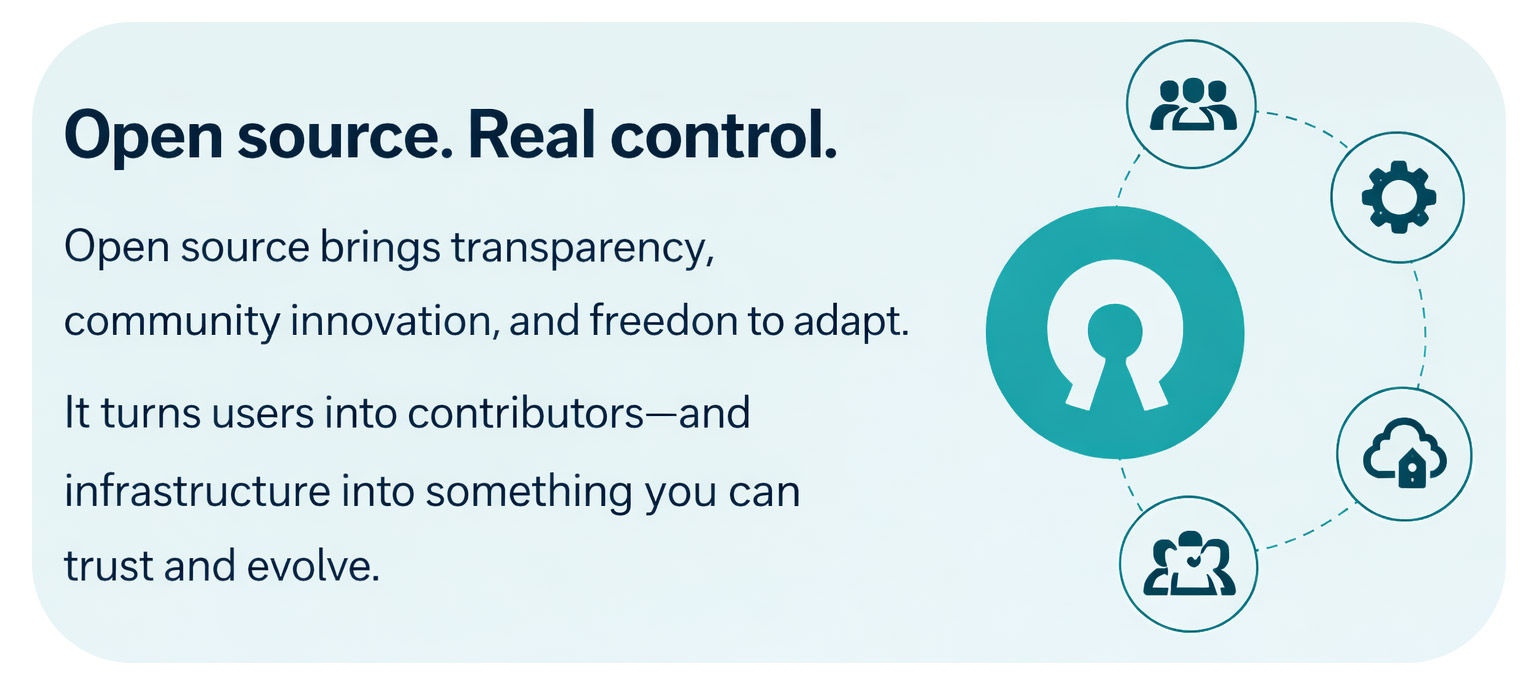
An informational graphic titled "Open source. Real control." explaining how open-source architecture brings transparency and adaptability. On the right, a diagram features a central open-source keyhole logo connected by a dotted line to four smaller icons representing community, development, cloud infrastructure, and verified users, illustrating unified system control.

Instead of being forced to depend entirely on opaque vendor logic, teams gain more transparency into how systems work. Instead of adapting blindly to product limitations, they can better evaluate, extend, and align the platform with their own needs.

For technical teams, that creates a very different kind of confidence.

Open-source infrastructure encourages collaboration, practical improvement, and community-driven evolution. It supports an environment where users are not just consumers of a platform, but participants in its progress.

In messaging, where reliability and adaptability matter deeply, that is a significant advantage.

The case for a modern SMS Gateway

A modern SMS Gateway should not be judged only by its ability to deliver messages.

It should be judged by how well it supports operational control.

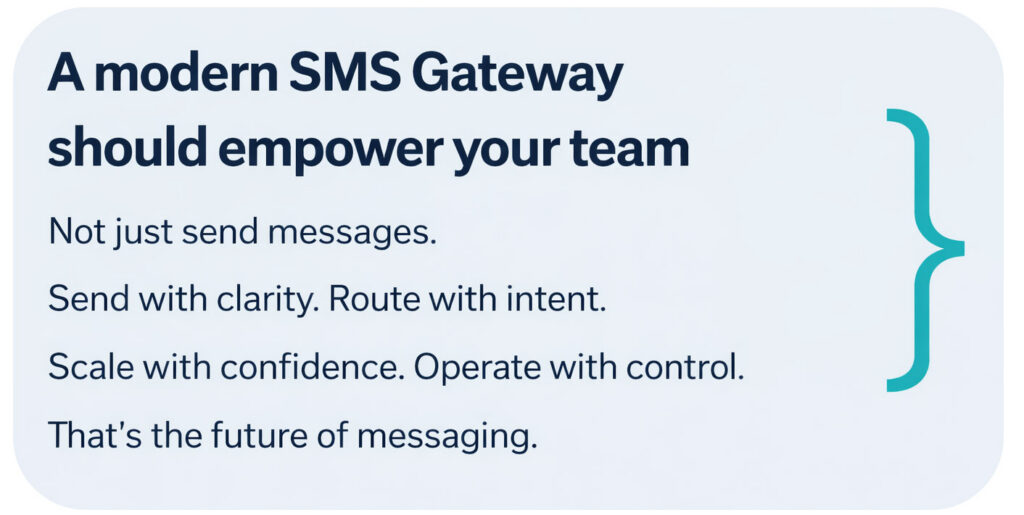
An informational graphic with a light blue background detailing the goals of a modern SMS Gateway. The text emphasizes empowering teams to go beyond basic message delivery by routing with intent, scaling with confidence, and operating with control. A stylized teal closing curly bracket accents the right side of the text block.

Can it help teams manage routing intelligently?
Can it support integration across different environments?
Can it provide visibility into the flow of traffic?
Can it scale with control rather than chaos?
Can it support real infrastructure freedom?


These are the questions that matter, because once messaging becomes business-critical, “sending SMS” is only the beginning.

Why Sendium is built around this idea

At Sendium, we believe messaging infrastructure should be transparent, flexible, and built for modern operational realities.

A dark blue promotional banner featuring the headline "The future of messaging is better control." Below it, text reads, "Sendium is built for teams who want transparency, flexibility, and true operational freedom." The right side displays a glowing cyan digital network diagram with a prominent, bright arrow sweeping upward and to the right through the interconnected nodes.

That means supporting real routing logic.

It means enabling control over throughput.
It means helping bridge different systems and protocols.
It means giving teams the visibility they need.
And it means respecting the fact that infrastructure decisions should remain in the hands of the people operating that infrastructure.

The future of messaging is not just faster delivery. It is better control.

And in modern SMS environments, control is no longer a luxury. It is the difference between infrastructure that merely exists and infrastructure that truly performs.

A dark blue banner featuring the text "Sendium is built for this future." above the tagline "Modern. Open-source. Built around control." The background is dominated by a sweeping, luminous wave of cyan digital data streams and glowing particles.
Latest News
Sendium open-source SMS gateway visual showing apps connected to SMS providers and message delivery.

Open Source SMS Gateway: Why It Matters

Open-source SMS gateways give businesses, developers, and telecom teams more control, transparency, and flexibility over critical messaging infrastructure. This article explores why open infrastructure matters for the future of SMS and how Sendium helps teams move beyond black-box gateway solutions.

Learn more
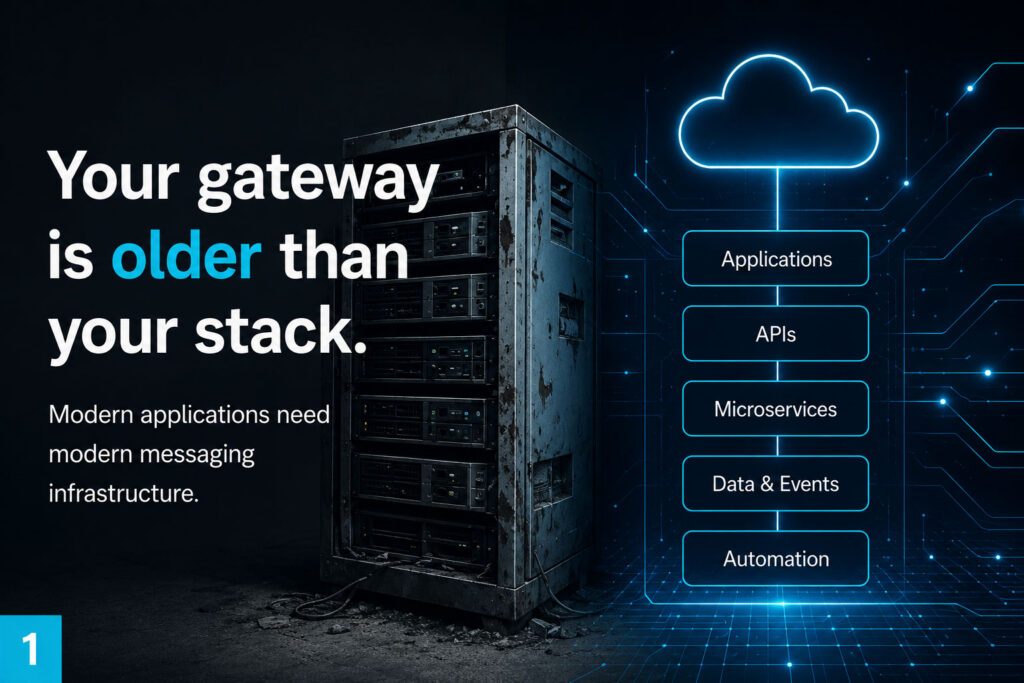
Modern SMS gateway infrastructure concept showing an outdated server rack contrasted with cloud applications, APIs, microservices, data events, and automation.

Your SMS Gateway Is Older Than Your Stack

Modern applications have evolved, but many SMS gateways still operate on legacy assumptions. In this article, we explore why messaging infrastructure needs more control, visibility, flexibility, and openness — and why Sendium is being built for the future of SMS gateway infrastructure.

Learn more