

Sendium: Building Transparent Messaging Infrastructure for the Real World
SMS is one of the most universal communication channels on the planet. It is simple, direct, globally compatible, and remarkably reliable. It works without internet access, across devices, across regions, and across generations of technology.
Yet the infrastructure behind SMS is far from simple.
Gateways, routing logic, provider integrations, compliance layers, delivery tracking, retries, throughput control — and the kind of hidden complexity that only appears when systems operate at scale. What looks easy on the surface quickly becomes operationally demanding when messaging becomes business-critical.
At Cytech Mobile, we have spent years building messaging software for organizations that care deeply about reliability, security, and operational visibility. We are an engineering-led company. We build systems meant to run in production. We also actively participate in the open-source ecosystem — not only by using it, but by contributing back to it.
Sendium was born at the intersection of those two realities.
The Pattern We Kept Seeing
Across enterprises, telecom providers, startups, and developers experimenting with messaging, the same needs appeared repeatedly.
Teams wanted cost-effective messaging operations without rebuilding core infrastructure from scratch. They needed strong security layers for sensitive flows such as OTP authentication. They wanted the ability to launch new messaging ventures — bulk SMS platforms, VoIP expansions, IoT notifications — without massive upfront investment. They also needed tooling flexible enough to support both serious production workloads and smaller experimental projects.
Most importantly, once SMS became part of a business-critical workflow, teams wanted control.
Control over routing logic.
Control over integrations.
Control over system behavior.
Control over visibility.
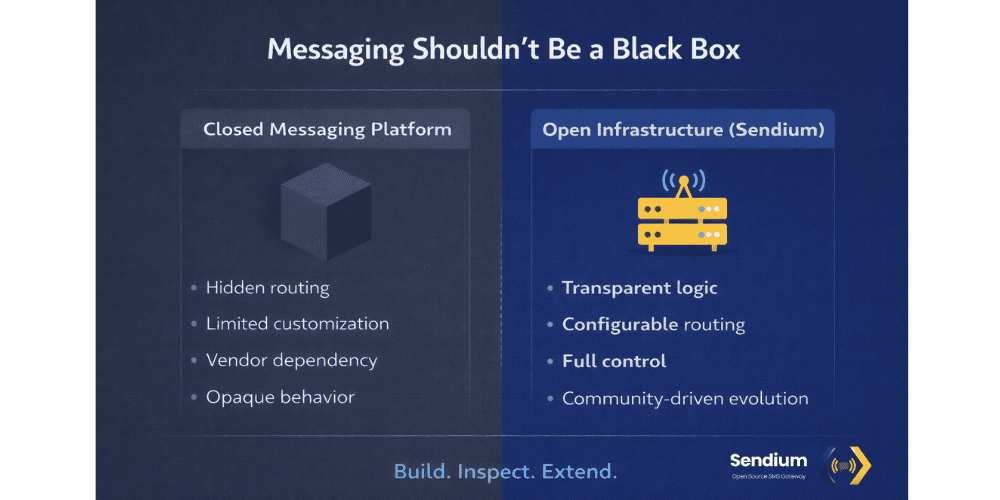
And too often, what they found instead were opaque systems — black boxes where behavior could not be inspected, extended, or adapted easily.
That gap is exactly where Sendium began.
Why Open Source Is the Right Foundation
We chose to build Sendium as an open-source project not as a marketing move, but as an architectural decision.
Modern messaging infrastructure demands transparency. When SMS powers authentication, financial alerts, medical notifications, or high-volume delivery workflows, organizations must understand how their system behaves. Open source makes inspection possible. It replaces blind trust with verifiable logic.
Extensibility is equally important. No two enterprises operate in identical conditions. Edge cases are the norm, not the exception. Open source normalizes extension: adding connectors, improving routing rules, enhancing documentation, refining UI experiences, and contributing tests — all in the open.
There is also a community dimension. Messaging infrastructure benefits from shared learning. A contributor ecosystem creates a feedback loop where improvements, bug fixes, and performance optimizations circulate quickly. Instead of isolated implementations, the software evolves collectively.
Finally, open source lowers the barrier to entry. Messaging is foundational infrastructure. It should not require prohibitive upfront investment simply to experiment, prototype, or launch.
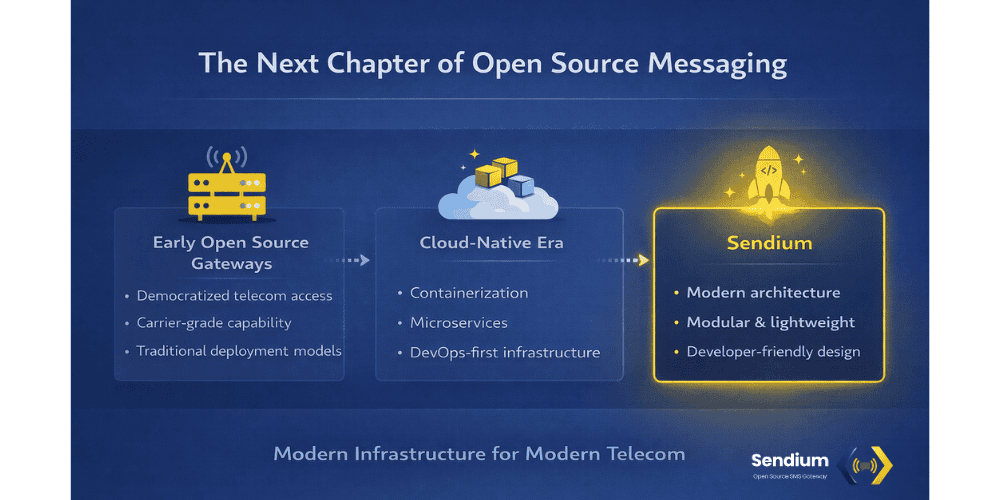
Open-source SMS gateways have existed for years, and we deeply respect the groundwork laid by earlier projects. Sendium is not a reinvention of history. It is an attempt to continue that spirit with a modern, community-driven gateway aligned with today’s expectations around developer experience, routing flexibility, and maintainability.
Why Sendium Is Open Source
| Principle | What It Means in Practice | Why It Matters |
|---|---|---|
|
Transparency |
Code and routing logic are visible and inspectable |
Builds trust in business-critical messaging workflows |
|
Extensibility |
Anyone can extend routing, integrations, or features |
Adapts to real-world edge cases without vendor dependency |
|
Community Collaboration |
Contributions improve the core platform |
Creates shared innovation and faster evolution |
|
Infrastructure Ownership |
Teams can deploy and operate independently |
Eliminates black-box constraints and lock-in |
|
Lower Barrier to Entry |
No heavy licensing or upfront costs |
Enables experimentation and new venture creation |
|
Long-Term Sustainability |
Community-driven development model |
Reduces reliance on proprietary roadmaps |
What Sendium Is
Sendium is an open-source SMS Gateway designed to send messages via API and route them dynamically using configurable rules.
Its architecture is built with modern development principles in mind. The backend is implemented in Java using Quarkus, enabling efficient, cloud-friendly performance. Routing rules are managed through a command-line interface and are loaded dynamically in real time, without requiring system restarts.
The project is released under the GPL-3.0 license, reinforcing its commitment to open collaboration and shared improvement.
At its core, Sendium is not just about sending SMS. It is about controlling how messages move through infrastructure.
Who We Are Building This For
Messaging ecosystems are diverse, and Sendium is intentionally built for multiple types of builders.
Enterprises such as banks, insurance providers, and large organizations that require reliability and delivery visibility can use Sendium as a controllable infrastructure layer. Developers prototyping internal tools or side projects can deploy it without the overhead of proprietary systems. Teams assembling their own communication stacks can integrate it as a foundational transport layer.
New bulk SMS providers can use it as a cost-effective operational starting point. VoIP providers exploring adjacent messaging services can expand into SMS without reinventing routing engines. IoT and M2M use cases — including telemetry, alerts, and monitoring systems — can leverage its dynamic routing capabilities for resilient delivery.
In short, Sendium is for those who want to own their messaging infrastructure rather than depend entirely on third-party abstractions.
Where Sendium Fits
Sendium is an open-source SMS Gateway designed for teams that want ownership and transparency in their messaging infrastructure. It provides SMPP connectivity downstream and an HTTP API upstream, forming a clean bridge between applications and telecom networks.
Its architecture is built for real-world operational environments. Routing logic is transparent and configurable. Failover strategies can be implemented deliberately. Delivery flows can be monitored and audited. Because Sendium is open source, organizations can inspect the logic, extend capabilities, customize integrations, and avoid vendor lock-in.
Rather than treating messaging as a closed system, Sendium enables teams to build and evolve their own messaging infrastructure with clarity and control.
Open Source and Enterprise Experience: Not Opposites
Open collaboration and enterprise-grade execution are often seen as separate worlds. In reality, they reinforce each other.
Sendium serves as an open foundation where real usage, feedback, and contributions shape the evolution of the gateway transparently. That ecosystem accelerates learning and exposes real-world edge cases early.
At the same time, Cytech Mobile operates with enterprise-level discipline. Our organization maintains ISO 27001 certification and applies GDPR-oriented operational practices. We understand production environments, compliance demands, and security expectations.
The combination matters. Open collaboration provides innovation velocity. Production experience provides stability and governance.
Together, they create a stronger foundation.
How You Can Get Involved
Sendium is intentionally starting with openness at its core. Contributions are welcome not only from developers, but from practitioners and operators who understand real messaging challenges.
Improving documentation, proposing routing scenarios, sharing deployment patterns, enhancing tests, refining the user experience, or opening issues based on real-world edge cases all help shape the roadmap.
If you have ever wanted to contribute to an open-source messaging gateway designed with both community values and real operational rigor in mind, this is your opportunity.
Explore the Sendium repository. Start a discussion. Open an issue. Shape the foundation.
The Bigger Picture
SMS may be simple on the surface, but the infrastructure behind it determines reliability, cost efficiency, and operational clarity.
We built Sendium because messaging infrastructure should be transparent, extensible, and community-driven. It should empower teams to understand and shape their systems — not depend on invisible logic.
Sendium is our open invitation to build that future together.