

The Infrastructure Behind Reliable Business Messaging
SMS remains one of the most dependable communication channels in the digital world. It works on virtually every mobile phone, does not depend on internet access, and achieves exceptionally high open rates. For banks sending one-time passwords, logistics companies delivering tracking updates, SaaS platforms verifying users, or healthcare providers confirming appointments, SMS is often mission-critical.
But behind every “simple” text message sent from an application lies a sophisticated layer of infrastructure. That layer is the SMS Gateway.
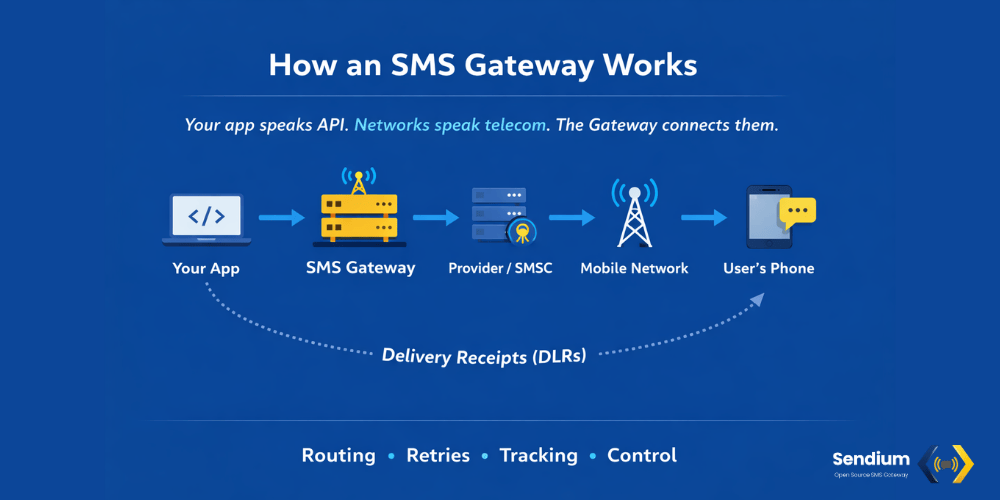
An SMS Gateway is the system that connects your software applications to mobile networks. Your web apps, mobile backends, CRM systems, banking platforms, or IoT services communicate through APIs. Mobile operators and telecom networks, on the other hand, operate using carrier-grade protocols such as SMPP. The gateway bridges these two worlds. It translates, routes, manages, tracks, retries, and reports every message so that delivery is reliable and observable.
Without this intermediary layer, messaging quickly becomes fragile and opaque.
Where the SMS Gateway Sits in the Flow
A typical message journey looks straightforward on the surface: your application sends a request, and the user receives a text. In reality, the flow involves multiple steps. The application sends the message to the SMS Gateway. The gateway routes it to a provider or SMSC. From there it enters the mobile network and reaches the user’s phone. Delivery receipts travel back through the same chain in reverse.
Upstream, applications interact with the gateway using a simple HTTP or REST API. Downstream, the gateway connects to telecom providers using protocols such as SMPP, which is the industry standard for high-volume messaging. The gateway effectively becomes the control center between your business systems and the carrier infrastructure.
What an SMS Gateway Actually Does
At first glance, an SMS Gateway may appear to be just a “send SMS” tool. In production environments, however, it functions as a full messaging control layer designed for reliability, scale, and operational intelligence.
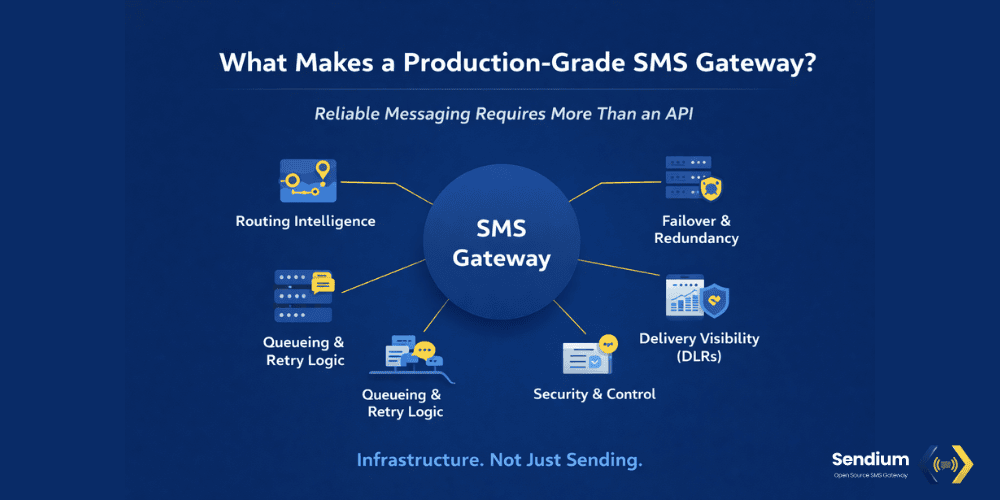
It begins with protocol translation. Applications communicate in HTTP. Telecom providers communicate in SMPP. The gateway manages these connections, maintains stable binds, handles reconnections, and ensures throughput control so that messages flow consistently even under heavy load.
Routing is where the real intelligence lies. A gateway decides how and where each message should be delivered. It can route traffic based on country, operator, sender ID, message type, cost considerations, or performance metrics. An OTP may be routed differently from a marketing campaign. If a provider underperforms or becomes unavailable, fallback logic can redirect traffic automatically to maintain continuity.
Reliability is equally critical. Messaging traffic is rarely uniform. Peaks occur during login waves, marketing launches, or emergency alerts. A robust gateway queues messages safely during traffic bursts, applies intelligent retry logic when temporary failures occur, and respects rate limits imposed by providers. This ensures that messages are not lost when systems are stressed.
Visibility is another fundamental capability. Businesses need to know whether a message was delivered, failed, or expired. Delivery receipts, commonly known as DLRs, allow internal systems to track the full lifecycle of each SMS. This visibility is essential for auditing, user experience optimization, and compliance requirements.
Security and operational governance complete the picture. A production-grade gateway provides authentication and authorization layers, sender ID controls, logging, and audit trails. It becomes not just a transport layer, but a managed messaging environment.
| Capability | What It Means in Practice | Why It Matters |
|---|---|---|
|
Protocol Translation |
Converts HTTP API requests into telecom protocols like SMPP |
Allows applications to communicate with carrier networks seamlessly |
|
Intelligent Routing |
Chooses delivery paths based on country, operator, cost, priority, or message type |
Optimizes cost, performance, and reliability |
|
Queueing & Traffic Control |
Buffers traffic during spikes and manages throughput limits |
Prevents message loss during high-load periods |
|
Retry & Failover Logic |
Automatically retries failed attempts and switches providers if needed |
Maintains delivery continuity and uptime |
|
Delivery Receipts (DLRs) |
Tracks message lifecycle from submission to final status |
Provides transparency and operational visibility |
|
Security & Governance |
Controls sender access, logs activity, enforces rules |
Ensures compliance and protects messaging integrity |
|
Observability |
Provides logs, metrics, and performance tracking |
Enables monitoring, troubleshooting, and optimization |
When Does a Business Need an SMS Gateway?
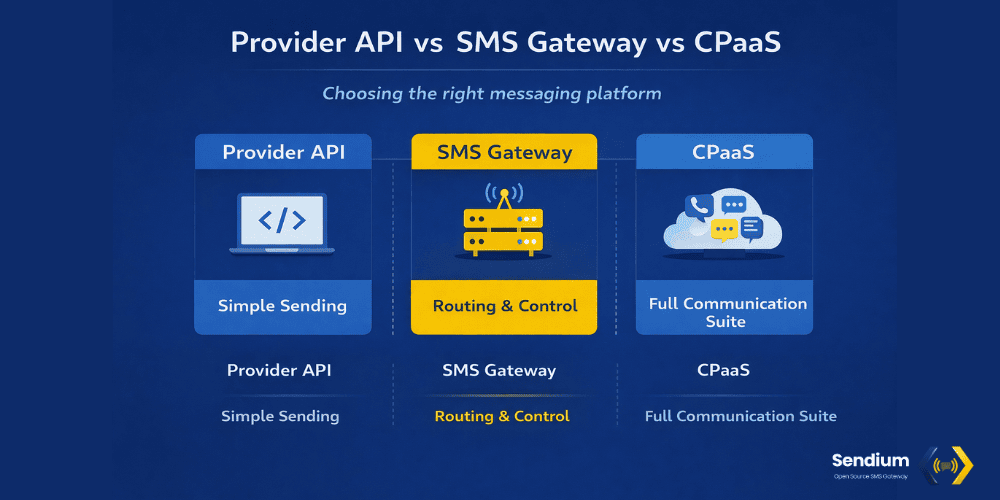
For very small use cases, a direct provider API may be sufficient. However, once messaging becomes business-critical, relying solely on a basic API often proves limiting.
An SMS Gateway becomes essential when reliability matters for OTP or two-factor authentication, when transactional alerts must reach users without fail, when campaigns scale to high volumes, or when multiple providers are required for redundancy and cost optimization. It is also critical when organizations want visibility into delivery performance, custom routing logic, or infrastructure ownership.
In short, if SMS affects customer trust, operational integrity, or revenue generation, a gateway is no longer optional — it becomes architectural infrastructure.
SMS Gateway vs CPaaS
It is common to compare SMS Gateways with CPaaS platforms. A CPaaS solution is typically a hosted, all-in-one communications platform that may include SMS, voice, WhatsApp, RCS, dashboards, compliance tooling, and number management.
An SMS Gateway, however, is more foundational. It focuses specifically on SMS transport, routing, and delivery control. It can serve as the engine behind a CPaaS platform or act as the core infrastructure within a company’s own messaging stack.
Organizations that value ownership, extensibility, and deeper control over routing logic often prefer a gateway-first approach as a long-term strategic foundation.
What Defines a Production-Grade SMS Gateway?
In enterprise environments, stability and observability are non-negotiable. A reliable SMS Gateway must support stable SMPP connectivity, provide a clear HTTP API for application integration, enable advanced routing logic, handle delivery receipts, manage queueing and retries, and support multi-provider failover. It must also offer logging, metrics, authentication controls, and operational simplicity.
Without these elements, messaging becomes a black box. With them, it becomes a controlled, resilient system.
Where Sendium Fits
Sendium is an open-source SMS Gateway designed for teams that want ownership and transparency in their messaging infrastructure. It provides SMPP connectivity downstream and an HTTP API upstream, forming a clean bridge between applications and telecom networks.
Its architecture is built for real-world operational environments. Routing logic is transparent and configurable. Failover strategies can be implemented deliberately. Delivery flows can be monitored and audited. Because Sendium is open source, organizations can inspect the logic, extend capabilities, customize integrations, and avoid vendor lock-in.
Rather than treating messaging as a closed system, Sendium enables teams to build and evolve their own messaging infrastructure with clarity and control.
The Takeaway
If SMS plays a meaningful role in your product or service, it deserves more than a simple send function. It requires infrastructure that provides reliability, routing intelligence, delivery visibility, and operational resilience.
An SMS Gateway transforms messaging from a feature into a dependable communication system.
Sendium is built to be that system — open, transparent, and designed for teams that want to own their messaging layer rather than outsource its logic.